


 Posts
Posts


To make things a little easier in case you wanted to find a specific story or recipe, I've created an index for the run of Selzer & Smuckles. This should be the first post to pop up when you click the "To Find All Selzer And Smuckles Posts..." link above.
Please go back and re-read these, or enjoy them for the first time. The fondest memories we have are those of when we read peoples' blogs. Shakespeare said that (or didn't...one of those two).
Introduction - Selzer & Smuckles
Easy Appetizers & Drink of Tomorrow
Fool's Rice
Perfect Hot Dogs Every Time
Basque Green Bean Salad
Toasted Nut Orzo
Satellite TV (warning, includes my scathing Mama Mia review)
Proper Omelette Technique
Galaxy Nachos
Flavor Burgers & Perfect Oven Fries Every Time
Hell Baby
Childhood Sandwich
The Dogg is Home
Homemade Mexican Pizza
Beer Can Chicken
Smoked Salmon on Potato Coins & Perfect Deviled Eggs Every Time
Microwave Egg Muffin
Vegetables Delight
Five Dollar Chili
Ruuude Chicken
Omega Potato
Chef Ray's No-Butter, No-Fry Hot Wings!
Brined Pork Tenderloin with Carmelized Onions
Scotch Eggs
12 Step Cookies
Prelude to the End
Diamond Juice & How You Gotta Enjoy Wine
T-Bone Steak & A Meditation on Home Fries
My Final Thoughts
Showing posts with label Selzer and Smuckles. Show all posts
Showing posts with label Selzer and Smuckles. Show all posts
Thursday, May 27, 2010

Monday, May 24, 2010
Selzer & Smuckles - My Final Thoughts
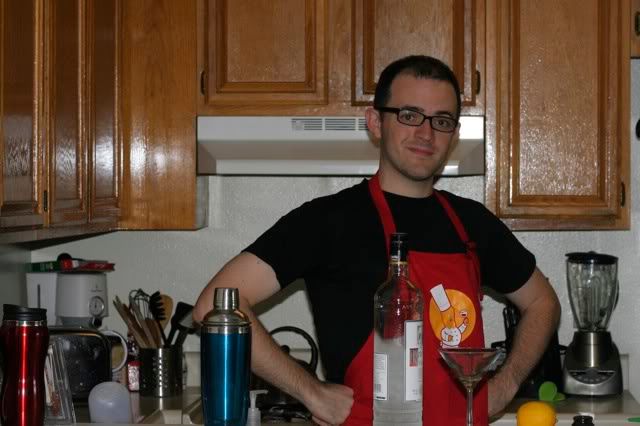 You see that? That picture is my attempt at recreating the cover of the Achewood Cookbook, seen here:
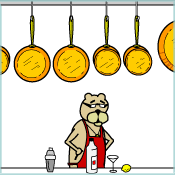 It is also the reason that I haven't posted anything here for nearly 3 months. Seriously. I knew my next blog post had to be the closing of the Selzer & Smuckles chapter, I had put it off long enough. I also knew that I wanted to take that picture. Unfortunately, as you can probably tell if you're reading this, will power is not always my strong suit. I refused to post until I had that picture, and every night I would get home and think, "I'll have to get the camera out of the bag. And then I'll have to clean off the counter. And then I'll have to get everything setup. Hey, The Simpsons is on!" Finally, I just went ahead and did it (it must have been a Lisa-heavy Simpsons episode) and here we are. Please note that I do not own copper pots and pans, nor do I have a hanging baker's rack (I could use one, but every time I think about it I remember I live in a state where the ground has a tendency to toss itself about without warning and I don't like the idea of a cast iron skillet crashing into my noggin when all I wanted was a bowl of Cheerios). I also own a blue cocktail shaker, not the classic silver, but the Ketel One, martini glass, and lemon were all meticulously placed.
So what did I learn from Selzer & Smuckles? First, I'm probably a better cook than I thought I was. Most of the recipes seemed a bit below my level of expertise, no matter how tasty the result. That said, I did learn how much can be found from the most basic of recipes. The 12-Step Cookies are now Melissa's favorite dessert, and I make them frequently for potluck type events. Toasted Nut Orzo has quickly made its way into my regular recipe rotation. In fact, we had it for dinner on Friday and are having it again this week (the ingredients are proportioned in a way that when you buy them, you have enough to make it twice). And the Fool's Rice has accompanied every stir fry I've made since the first time I've tried it. The Meditation on Home Fries has proven the perfect way to cook potatoes for an easy (if not necessarily fast) side (Melissa loves these, too). The Scotch Eggs and Ray's Hot Wings have both merited repeat eatings, as well. Not a bad haul for a cookbook that mostly plays itself for jokes.
I have also learned how much trial and error there really is in cooking. There is no doubt in my mind that the Perfect Oven Fries and Flavor Burgers are solid recipes and that I screwed them up somehow. Due to differences in appliances and cookware, slavishly following a recipe can be hazardous. I've started to learn to cook more by instinct, and I'm enjoying the creative feeling of it. And several techniques took many tries to master. Just last weekend I finally made a Proper Omelette perfectly for the first time. I've been attempting it every time I make omelettes since I first posted about them last August (and I make omelettes fairly frequently). But it took until now to roll the egg on to itself without a spatula and have it finish cooking without really browning. Watching that perfectly yellow cloud of egg slide off of my pan and on to my plate is one of my proudest moments in the kitchen.
I also learned to appreciate good liquor. The Ketel One in my freezer has provided me much more enjoyment than the Smirnoff on the counter (which is now just for mixin').
Where do I go from here? Well, there's no shortage of cookbooks in the world, though I don't think I want to go trekking through another one in its entirety anytime soon. If I do, the top candidate is Tom Colicchio's Think Like a Chef, which reads almost like a textbook and comes from a chef I really admire. I'm currently reading the book, not cooking yet, and I've already learned more about cooking than I would have expected from any book. Melissa just got me Hubert Keller's Burger Bar cookbook for our anniversary, and that looks like a lot of fun. She also bought be a nice kitchen scale so I can dive into Michael Ruhlman's Ratio in earnest. In short, I'm trying to move myself more towards creating than just following instructions. As for the blog, don't expect to see the food posting stop anytime soon. I got a lot of positive responses from this project and really enjoyed it myself. That being said, I don't think I want to make this strictly a "food blog." There's already a billion of those out there and I don't really want to tie myself down to one topic.
But I guess that's it for now. I thoroughly enjoyed Selzer & Smuckles and I hope that you did too. I laughed more than I should from a cookbook and enjoyed a lot of great food. I really finished this project months ago, and looking back on it now made me realize how much I've missed it. But what can I do? I reached the end of the book and that's all there is to it. Even if I wanted to go through the hard work again, I couldn't do it. I mean, unless they put out a second Achewood cookbook. Wait a minute. What's that? Son of a bitch.
Cheers,
Eli
Tuesday, November 24, 2009
T-Bone Steak ("Ray Steak," p.28), A Meditation on Home Fries (p.10)
Well, here we are. Sorry for the delay, but I just couldn't seem to bring myself to write this one. I mean, the last recipe from the Achewood Cookbook. Could I really be finished? I have a hard time finishing projects. When I get to the end of a screenplay, I always drag my feet for a few days when I get to the third act. It always feels like I'm killing off a friend, or worse, a child (seeing as how it's something I've created). If I've done a good job creating characters, I feel like I'm going to miss them, and miss creating their world. There may not be any characters (aside from myself and the food) in this blog, but the feeling is the same. It took me a long time to gather the courage to log on and write this thing. I CRIED 8 OR 9 TIMES (not really). Oh well, on to the final recipe.
I knew the last meal would have to be a big deal (and it's important to me that this sentence rhymed), and dogeared this recipe specifically for the grand finale. Nothing says "class" and "celebration" quite like a T-Bone Steak (or, as the book subtitles it, Ray Steak). And since the recipe recommended it, I served it up with Roast Beef's Meditation on Home Fries. As my brother so succinctly reminded me, "French fried potatoes and a T-Bone steak." A more classic meal there isn't. Let's start with the potatoes.
I was nervous about this one. My last fried potato experience with Achewood hadn't gone well. But I was determined to make this meal special, and I wasn't going to let some starches and oils stand in my way. There's a lot of text in the recipe where Roast Beef tries to come up with a universal standard for what constitutes "home fries." It's simple really: small, computer keyboard sized cubes of potato, salted and pan fried in oil. Don't go loading a bunch of dang spices on them or throw in vegetables to make them fancy. Potatoes are a staple, and they're perfectly fine without a lot of fancy presentation. Red potatoes were recommend, as their texture and consistency lends itself well to the cooking process. They took longer to cook than I had expected them to, but I was mostly able to let them sit while I focused on the steak. In this recipe, Roast Beef confirms my feelings that one of the things a young chef needs to learn is the confidence to let things sit alone in hot oil and cook without disturbing them. I'm pretty sure I've talked about this before, but I don't feel like digging through the archives to find the article. You do it.
The finished product was a complete opposite result of the "perfect oven fries." These things were delicious. The potato cubes were crunchy on the outside and creamy on the inside, just enough salt to add a nice seasoned kick- a perfect compliment to any meal. Melissa and I both loved them. Possibly the best preparation of potatoes I have ever done. If you were to take the cubes and build them into a castle or something, you could serve these in any fancy, pretentious restaurant. That sort of goes against Beef's whole manifesto, though. Still, you get the idea, these things are good. See for yourself:
 And that blows the surprise on the steak, so let's jump right in. The t-bone is a large cut of meat - each one is over a pound (and I asked for small ones). I'm not that familiar with the cut, I prefer a ribeye or prime rib for my "special times" steak. Hm, "special times steak" seems to imply something sexual...it's not intentional, but I'm not going to change it. I have cooked steak many times before. I try not to eat too much red meat, but for a meal where you feel like rewarding yourself, you can't go wrong with a good steak. Still, I usually cook my steaks on a grill. I currently have a tiny, insufficient camping grill that is capable of cooking two average sized steaks in approximately an hour and a half. No worries, this is a stove cooked steak. This is important because without a pan, you can't make the red wine reduction that constitutes the sauce for the dish.
Teodor walks you through this recipe, and it shows. Even though there's nothing terribly complicated in the instructions, everything is described in a way that makes you feel like you are doing something fancy. I had to cook these in two separate stainless steel pans - I didn't have one that was big enough for both of the steaks. I got the feeling that cast iron is probably a better fit for this one. My beautiful stainless pans were charred and black when I was through cooking, even after deglazing. Don't worry, they cleaned out ok (I know you were worried). But I've told you time and time again- I just don't have room for a decent cast iron skillet, nor do I have the patience to season one. If you have a pre-seasoned one you want to send me with a suggestion of where to put it, I'll accept it. E-mail me and I'll tell you where to send it. Outside of that, I'll make do with what I have.
The recipe makes a big deal out of letting the steak sit out before and after cooking. This lets the juices adjust properly to their new situations and means you won't be left with a sloppy mess on the plate. Top Chef has made a point of this, too. I had never known it before I undertook this cooking project, and now it just seems like common sense. It's amazing how fast you can start to feel like a smug, elitist, expert, a-hole. When you flip the steaks (which is really all you have to do in this recipe) Teodor tells you to put a brick wrapped in foil on top of it to prevent the natural bowing that happens from having one side of the meat cooked and the other not. Well, you know what, I don't keep bricks laying around. Is this a common thing? Am I supposed to steal a brick from a construction site? Or is the book assuming that its target demographic will just take the brick that's holding up their coffee table? Either way, Teodor does offer the alternative of weighing down a heavy pan with cans for the same effect, and this is what I was prepared to do. However, I forgot about it because I was afraid my kitchen was about to catch on fire.
See, steaks on the stove smoke. A lot. And my burners were burning a bright shade of orange I've never seen them glow before. Usually they stay a serene, happy blue. So, as the steaks were going all concave, my apartment was filling with smoke and the fire alarm was blaring. That kind of became focus number 1. Apparently the tiny ventilation hood on our oven is not equipped to handle this kind of cooking. I can't say I'm surprised, it's a sad little stove/oven, the kind you get the feeling Sears gave away for free in 1976 if you bought a fridge from them. Melissa helped to fan the smoke out the window and eventually things calmed down, but it was probably as panicked as I've ever been in the kitchen. My response to panic is to get all depressed and apologetic, but it passed. And when it did, it was time to make the sauce.
I've deglazed and made reductions once or twice, but it's always fun to hear that sizzle. Plus, this was the first time since I got my stainless pans so I was actually able to scrape up the little black bits like the recipe told me to. I kept expecting the sauce to thicken more, especially when I added the "cornstarch slurry," but it remained ever-liquid. The recipe said it should turn to a gravy-like consistency, which I took to mean kind of thick and syrupy. Melissa thought that the runny sauce seemed like gravy to her, and I can see her point. Gravy is kind of a broad term to use as a descriptor. Either way, it was delicious. The steak didn't really need the sauce since it was plenty tender and juicy, but the vegetables and the wine really enhanced the flavors. It was smoky and rich and every bit as good as anything I've made on the grill. It came out a perfect medium rare, which I was happy about. Between the steak, the potatoes, the Diamond Juice and the wine, it all felt very decadent. A fitting end to a fun experiment.
Well, since this post has run on long enough, I guess I lied to you. This isn't the last one. I'll post a wrap-up in the next couple of days where we'll reflect on what we've learned on this journey and a bunch of other hippie crap. Join us next time for a time of reflection.
Cheers!
Eli
I knew the last meal would have to be a big deal (and it's important to me that this sentence rhymed), and dogeared this recipe specifically for the grand finale. Nothing says "class" and "celebration" quite like a T-Bone Steak (or, as the book subtitles it, Ray Steak). And since the recipe recommended it, I served it up with Roast Beef's Meditation on Home Fries. As my brother so succinctly reminded me, "French fried potatoes and a T-Bone steak." A more classic meal there isn't. Let's start with the potatoes.
I was nervous about this one. My last fried potato experience with Achewood hadn't gone well. But I was determined to make this meal special, and I wasn't going to let some starches and oils stand in my way. There's a lot of text in the recipe where Roast Beef tries to come up with a universal standard for what constitutes "home fries." It's simple really: small, computer keyboard sized cubes of potato, salted and pan fried in oil. Don't go loading a bunch of dang spices on them or throw in vegetables to make them fancy. Potatoes are a staple, and they're perfectly fine without a lot of fancy presentation. Red potatoes were recommend, as their texture and consistency lends itself well to the cooking process. They took longer to cook than I had expected them to, but I was mostly able to let them sit while I focused on the steak. In this recipe, Roast Beef confirms my feelings that one of the things a young chef needs to learn is the confidence to let things sit alone in hot oil and cook without disturbing them. I'm pretty sure I've talked about this before, but I don't feel like digging through the archives to find the article. You do it.
The finished product was a complete opposite result of the "perfect oven fries." These things were delicious. The potato cubes were crunchy on the outside and creamy on the inside, just enough salt to add a nice seasoned kick- a perfect compliment to any meal. Melissa and I both loved them. Possibly the best preparation of potatoes I have ever done. If you were to take the cubes and build them into a castle or something, you could serve these in any fancy, pretentious restaurant. That sort of goes against Beef's whole manifesto, though. Still, you get the idea, these things are good. See for yourself:
And that blows the surprise on the steak, so let's jump right in. The t-bone is a large cut of meat - each one is over a pound (and I asked for small ones). I'm not that familiar with the cut, I prefer a ribeye or prime rib for my "special times" steak. Hm, "special times steak" seems to imply something sexual...it's not intentional, but I'm not going to change it. I have cooked steak many times before. I try not to eat too much red meat, but for a meal where you feel like rewarding yourself, you can't go wrong with a good steak. Still, I usually cook my steaks on a grill. I currently have a tiny, insufficient camping grill that is capable of cooking two average sized steaks in approximately an hour and a half. No worries, this is a stove cooked steak. This is important because without a pan, you can't make the red wine reduction that constitutes the sauce for the dish.Teodor walks you through this recipe, and it shows. Even though there's nothing terribly complicated in the instructions, everything is described in a way that makes you feel like you are doing something fancy. I had to cook these in two separate stainless steel pans - I didn't have one that was big enough for both of the steaks. I got the feeling that cast iron is probably a better fit for this one. My beautiful stainless pans were charred and black when I was through cooking, even after deglazing. Don't worry, they cleaned out ok (I know you were worried). But I've told you time and time again- I just don't have room for a decent cast iron skillet, nor do I have the patience to season one. If you have a pre-seasoned one you want to send me with a suggestion of where to put it, I'll accept it. E-mail me and I'll tell you where to send it. Outside of that, I'll make do with what I have.
The recipe makes a big deal out of letting the steak sit out before and after cooking. This lets the juices adjust properly to their new situations and means you won't be left with a sloppy mess on the plate. Top Chef has made a point of this, too. I had never known it before I undertook this cooking project, and now it just seems like common sense. It's amazing how fast you can start to feel like a smug, elitist, expert, a-hole. When you flip the steaks (which is really all you have to do in this recipe) Teodor tells you to put a brick wrapped in foil on top of it to prevent the natural bowing that happens from having one side of the meat cooked and the other not. Well, you know what, I don't keep bricks laying around. Is this a common thing? Am I supposed to steal a brick from a construction site? Or is the book assuming that its target demographic will just take the brick that's holding up their coffee table? Either way, Teodor does offer the alternative of weighing down a heavy pan with cans for the same effect, and this is what I was prepared to do. However, I forgot about it because I was afraid my kitchen was about to catch on fire.
See, steaks on the stove smoke. A lot. And my burners were burning a bright shade of orange I've never seen them glow before. Usually they stay a serene, happy blue. So, as the steaks were going all concave, my apartment was filling with smoke and the fire alarm was blaring. That kind of became focus number 1. Apparently the tiny ventilation hood on our oven is not equipped to handle this kind of cooking. I can't say I'm surprised, it's a sad little stove/oven, the kind you get the feeling Sears gave away for free in 1976 if you bought a fridge from them. Melissa helped to fan the smoke out the window and eventually things calmed down, but it was probably as panicked as I've ever been in the kitchen. My response to panic is to get all depressed and apologetic, but it passed. And when it did, it was time to make the sauce.
I've deglazed and made reductions once or twice, but it's always fun to hear that sizzle. Plus, this was the first time since I got my stainless pans so I was actually able to scrape up the little black bits like the recipe told me to. I kept expecting the sauce to thicken more, especially when I added the "cornstarch slurry," but it remained ever-liquid. The recipe said it should turn to a gravy-like consistency, which I took to mean kind of thick and syrupy. Melissa thought that the runny sauce seemed like gravy to her, and I can see her point. Gravy is kind of a broad term to use as a descriptor. Either way, it was delicious. The steak didn't really need the sauce since it was plenty tender and juicy, but the vegetables and the wine really enhanced the flavors. It was smoky and rich and every bit as good as anything I've made on the grill. It came out a perfect medium rare, which I was happy about. Between the steak, the potatoes, the Diamond Juice and the wine, it all felt very decadent. A fitting end to a fun experiment.
Well, since this post has run on long enough, I guess I lied to you. This isn't the last one. I'll post a wrap-up in the next couple of days where we'll reflect on what we've learned on this journey and a bunch of other hippie crap. Join us next time for a time of reflection.
Cheers!
Eli
Wednesday, November 18, 2009
Diamond Juice (p.9) and How You Gotta Enjoy Wine (p.43)
I started my journey through this cookbook with a couple of drink recipes, so it makes sense that I would end things the same way. Yes, friends, we have arrived at the last meal of Selzer & Smuckles. This post is part 1 of 2, as it was quite a meal. Today, we focus on the liquid. We'll start with the wine, since it's a little less interesting. Ray's How You Gotta Enjoy Wine is not and does not pretend to be a recipe. It's just a little article teaching the very basics of wine consumption. This is the kind of thing I already know. I mean, I've seen and read Sideways, so I'm practically a professional sommelier (interesting note- one of the few instances where the movie is better than the book). But, I once again must remember this book's target audience - the clueless oaf in his backwards baseball cap. This is probably very informative for him.
All of the basics are here. White wine goes in the skinnier glass and is held by the stem (so as not to warm it with body temperature), and reds go in the more globular glass and are held by the bowl. This is related to the fact that whites should be chilled, and reds room temperature. This is something of which I still can't convince Melissa. She likes her wine chilled regardless of color, tradition and general knowledge be damned! I love her too much to force the issue, but I did make her drink a room temperature red for this project (She didn't mind, she just prefers chilled). In this case, it was a Syrah. A 2007 local (Santa Barbara) that was quite drinkable. A little watery, maybe, but there was enough flavor there. We bought it as part of the 5 cent wine sale at BevMo (by one bottle of wine, get another bottle of the same wine for a nickel), and it was certainly the best 5 cent wine I've ever had. Honestly, the $15 bottle was good, too. It all comes down to one of Ray's other wine rules - A wine should not taste terrible. This is a big one. I hear a lot of people my age talk about how they don't like wine, and this is generally a good sign that I'm dealing with someone who needs to do some growing up. Put down the Miller High Life and take a sip of a decent wine. Congratulations, you're an adult (unless you didn't like it, in which case, keep trying).
The one thing I didn't do with this wine that Ray recommended was decant it. I don't own a decanter. I considered buying one recently at Disneyland. For part of the Haunted Mansion 40th anniversary, the artist SHAG created a bunch of art and merchandise. I bought quite a few pieces, including the water bottle from which I currently drink, and seriously thought about buying a decanter with Shag's rendition of the changing Medusa painting and some ghosts on it. I imagined myself hosting a dinner party and finishing the night by bringing out some port in the ghostly decanter and offering some "spirits" to guests. They'd laugh and whisper amongst themselves about how witty I was. However, I had already bought some old fashioned glasses (like the bourbon drink, not in the style of antiquity) with similar logos and just couldn't bring myself to splurge. Plus, I have so much Haunted Mansion memorabilia that I was already risking crossing the line from "Disney Fan" to "Disney Collector." That line scares me. I've seen Disney Collectors, and they are not something I aspire to be. I make no promises about not buying it if its still available on my next trip. Anyway, Ray recommends if you don't have a decanter to pour the wine in a bowl and serve it with a turkey baster. I decided not to. The wine tasted fine after letting it breathe in the bottle, and I didn't feel it needed decanting. I may try it at a party in the future, just so people can see how classy I am.
Speaking of classy, Diamond Juice. Ray's favorite drink has been on my list for the final meal since I first flipped through the cookbook. See, Ray used to have an advice column, in which he would often give advice on libations. He made it clear that his choice of vodka was Ketel One. I've been wanting to buy a bottle ever since, but always made excuses not to (mostly, that's crap's expensive). Well, to celebrate the end of the project, I caved and bought a bottle. It didn't hurt that in the recipe for the final meal (you'll find out what it is soon enough), Ray recommends having some while you prepare it. So, some diamond juice to celebrate!
 You may be thinking- that just seems like a glass of vodka. You would be correct. Ray admits up front that there's no such thing as a recipe for a Ketel One martini (which is essentially what Diamond Juice is). Chilled vodka in a chilled martini glass. You wouldn't want to try this with Popov or even Absolut or Smirnoff, but Ketel One is damn smooth and drinkable. Even Melissa finished hers, and she's not as used to straight liquor as I am (she doesn't drink single malt Scotch and Whiskey like I do).
There is one more element to the drink, and you can see it in the picture - lemon zest. I do not own a lemon zester. Somehow, in all of the barware kits I've had over the years, I still don't have one in my collection. Ray says he got his for his birthday from Pat, and if you don't have one you should either use a vegetable peeler (which I did) or tell Pat when your birthday is (August 17, Pat, but Christmas is coming...). The vegetable peeler made a serviceable, if ugly, zest of lemon. I squeezed the zest over the drink to release essential oils, as instructed. I don't know whether this made any difference or not, but I didn't notice much lemon essence in my drink. I used the zests as a garnish, just so it didn't feel like I was wasting them. Melissa's fell into her drink, and she left it there. She probably got more lemon than I did. Still, it didn't really need it. I really enjoyed drinking my vodka straight (just the way Viktor learned to in Billy Joel's Leningrad), and I felt damn classy just sitting on the couch. Plus, now I have a bottle of Ketel One for future cocktail nights, so it's a big win for me.
That's about all there is to say about the drinks. It should surprise no one that this cookbook included 4 drink recipes, and they were all brought to you by Ray. The man/cat likes his liquor. I'll be back tomorrow or Friday with the big post with the final recipes! That's right, there's two of them. Want to know what they are? Then keep checking back, sucker!
Cheers,
Eli
All of the basics are here. White wine goes in the skinnier glass and is held by the stem (so as not to warm it with body temperature), and reds go in the more globular glass and are held by the bowl. This is related to the fact that whites should be chilled, and reds room temperature. This is something of which I still can't convince Melissa. She likes her wine chilled regardless of color, tradition and general knowledge be damned! I love her too much to force the issue, but I did make her drink a room temperature red for this project (She didn't mind, she just prefers chilled). In this case, it was a Syrah. A 2007 local (Santa Barbara) that was quite drinkable. A little watery, maybe, but there was enough flavor there. We bought it as part of the 5 cent wine sale at BevMo (by one bottle of wine, get another bottle of the same wine for a nickel), and it was certainly the best 5 cent wine I've ever had. Honestly, the $15 bottle was good, too. It all comes down to one of Ray's other wine rules - A wine should not taste terrible. This is a big one. I hear a lot of people my age talk about how they don't like wine, and this is generally a good sign that I'm dealing with someone who needs to do some growing up. Put down the Miller High Life and take a sip of a decent wine. Congratulations, you're an adult (unless you didn't like it, in which case, keep trying).
The one thing I didn't do with this wine that Ray recommended was decant it. I don't own a decanter. I considered buying one recently at Disneyland. For part of the Haunted Mansion 40th anniversary, the artist SHAG created a bunch of art and merchandise. I bought quite a few pieces, including the water bottle from which I currently drink, and seriously thought about buying a decanter with Shag's rendition of the changing Medusa painting and some ghosts on it. I imagined myself hosting a dinner party and finishing the night by bringing out some port in the ghostly decanter and offering some "spirits" to guests. They'd laugh and whisper amongst themselves about how witty I was. However, I had already bought some old fashioned glasses (like the bourbon drink, not in the style of antiquity) with similar logos and just couldn't bring myself to splurge. Plus, I have so much Haunted Mansion memorabilia that I was already risking crossing the line from "Disney Fan" to "Disney Collector." That line scares me. I've seen Disney Collectors, and they are not something I aspire to be. I make no promises about not buying it if its still available on my next trip. Anyway, Ray recommends if you don't have a decanter to pour the wine in a bowl and serve it with a turkey baster. I decided not to. The wine tasted fine after letting it breathe in the bottle, and I didn't feel it needed decanting. I may try it at a party in the future, just so people can see how classy I am.
Speaking of classy, Diamond Juice. Ray's favorite drink has been on my list for the final meal since I first flipped through the cookbook. See, Ray used to have an advice column, in which he would often give advice on libations. He made it clear that his choice of vodka was Ketel One. I've been wanting to buy a bottle ever since, but always made excuses not to (mostly, that's crap's expensive). Well, to celebrate the end of the project, I caved and bought a bottle. It didn't hurt that in the recipe for the final meal (you'll find out what it is soon enough), Ray recommends having some while you prepare it. So, some diamond juice to celebrate!
You may be thinking- that just seems like a glass of vodka. You would be correct. Ray admits up front that there's no such thing as a recipe for a Ketel One martini (which is essentially what Diamond Juice is). Chilled vodka in a chilled martini glass. You wouldn't want to try this with Popov or even Absolut or Smirnoff, but Ketel One is damn smooth and drinkable. Even Melissa finished hers, and she's not as used to straight liquor as I am (she doesn't drink single malt Scotch and Whiskey like I do).There is one more element to the drink, and you can see it in the picture - lemon zest. I do not own a lemon zester. Somehow, in all of the barware kits I've had over the years, I still don't have one in my collection. Ray says he got his for his birthday from Pat, and if you don't have one you should either use a vegetable peeler (which I did) or tell Pat when your birthday is (August 17, Pat, but Christmas is coming...). The vegetable peeler made a serviceable, if ugly, zest of lemon. I squeezed the zest over the drink to release essential oils, as instructed. I don't know whether this made any difference or not, but I didn't notice much lemon essence in my drink. I used the zests as a garnish, just so it didn't feel like I was wasting them. Melissa's fell into her drink, and she left it there. She probably got more lemon than I did. Still, it didn't really need it. I really enjoyed drinking my vodka straight (just the way Viktor learned to in Billy Joel's Leningrad), and I felt damn classy just sitting on the couch. Plus, now I have a bottle of Ketel One for future cocktail nights, so it's a big win for me.
That's about all there is to say about the drinks. It should surprise no one that this cookbook included 4 drink recipes, and they were all brought to you by Ray. The man/cat likes his liquor. I'll be back tomorrow or Friday with the big post with the final recipes! That's right, there's two of them. Want to know what they are? Then keep checking back, sucker!
Cheers,
Eli
Tuesday, November 17, 2009
Storm's A-Brewin
Hey everybody. Not really a big post, but I wanted to let you know I haven't forgotten about you. I know I didn't post anything last week, but I'm making up for it this week with...the end of Selzer & Smuckles! I'm not quitting, it's just finishing up. I have four recipes/articles to cover, and I did them all in one big meal on Sunday. I'm going to split it up into two posts and then probably post an ending summary, if I feel like it. It's going to be a good one folks. Stick around.
Cheers,
Eli
Cheers,
Eli
Friday, November 6, 2009
12 Step Cookies (p.42)
As promised, I'm here on Friday. No slaps for you! One thing I've noticed from watching food television is that most chefs are not necessarily good bakers. In cooking competitions, if dessert comes into play, many great chefs start to panic. I'm kin of the same way. I love cooking over flame, or even tossing a pizza into the oven, but I'm not that comfortable with cakes and cookies and such. So, I considered Pat's 12 Step Cookies to be something of a challenge. As a side note, Pat sure has a lot of recipes in this thing. I've always considered him to something of a side character in the strip, but this cookbook is teeming with his arrogant recipes. And hey, he's a vegan! He can't put eggs into these cookies! I call foul, Achewood!
Anyway, cookies. I love to eat them, not good at making them. I was scared. There, you're caught up. Pat starts by instructing you to follow the recipe EXACTLY. Some recipes you can play around with and make your own, but not baked goods. As the book points out, these things are more like scientific formulas than regular recipes. Not in like a molecular gastronomy way, necessarily, it's just important not to go out and try and add your own spices or your cookies will go awry. Of course, being Pat, he yells all of this at you. The editor (Chris Onstad, I assume) chastises him, but agrees not to mess around with this recipe. When someone's nervous about making cookies, this isn't the best way to calm them down.
But I went ahead and started preparing the recipe and had a pretty good dough forming. I almost stopped there and just ate the dough because it's the baking where these things tend to fail. The dough itself is delicious, why worry about cooking it? Salmonella, I guess, but in the modern age of pasteurized eggs, it's probably not that much of a threat. Well, I had a cookbook project to complete for the blog, so I went ahead and fired up the oven. As I was starting to
spoon up the dough, I noticed a sticker:
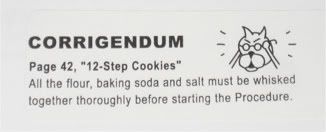 Are you kidding me!? You go to the hassle of YELLING at me to follow your recipe EXACTLY and you have the BALLS to stick this sticker at the END of the recipe?! Well, great! Now I have a ruined batch of cookie dough melting in a bowl and I have to start ALL THE HELL OVER?? Screw you, Achewood cookbook!!! (Note- This didn't actually happen. I read ahead in every recipe to make sure I can prepare my mise en place. This was an exercise of "creative writing." I thought it would be funny. For those of you not familiar with creative writing, it's where you write about "fiction" or things that didn't actually happen. Examples include screenwriters, novelists, and Fox News reporters. You may proceed with the article now).
Ok, well, back in the real world, I pulled out my cookie sheets (which have maybe actually been used for cookies once, when Melissa made some) to get the dough rolled up. Pat recommends using the wrappers from the butter sticks you used in the dough to grease the cookie sheet. I have to say, it worked really well. It looked at first like there wasn't anything stuck to the wrapper and that it wouldn't have any effect, but it surprisingly well-greased and it did a perfect job of keeping the cookies from sticking. I'm sure this tip comes up in Heloise or one of the other old ladies that tells people how to live their lives, but I heard it first from a cartoon cat, and that's the advice I'm more likely to take, anyway. I also liked the tip about rotating the cookies halfway through cooking because the oven cooks differently in different places. It all came together to make a damn fine cookie:
 They were kinda huge. I mean, you can't quite tell from the picture, but these suckers were thick. Seriously, one or two of these things was plenty. I'm normally a 3-4 cookie at a time kind of guy (which is probably a bad habit, anyway, and explains why I have to run 20 miles a week to keep in shape), but these ones filled me up. They were gooey and VERY chocolaty. The recipe only made about 16 cookies, but used an entire bag of chocolate chips. You would be eating one and suddenly tap into a lode of rich chocolate, like a miner discovering oil or melted diamonds or whatever it is miners find that's liquid. We ate a couple of the cookies and stuck the rest in a tupperware with a slice of bread. This is something I learned from my mom, not a cartoon cat. The bread seems to absorb whatever it is that dries cookies out in the atmosphere of a tupperware container and keeps the cookies nice and chewy for a long period of time. The bread, on the other hand, feels like a cracker. It's a neat trick, and I don't know what makes it work. The cookies lasted about a week, which in our house is a pretty significant amount of time for sweets to last. We just couldn't eat that many of them at once. So, I guess that's it. I conquered my fear and made a tasty treat that can be enjoyed by anyone- I mean, who doesn't like a cookie? Everyone from Jesus to Hitler likes cookies. Yes, even Albert Einstein (probably). I'll make them again, saying I"m going to take them to a potluck or something, but I'll probably eat them myself. That's all for now. Only a couple of posts left in the series, people. Start planning your "End of Selzer & Smuckles" parties now. Until then...
Cheers,
Eli
Anyway, cookies. I love to eat them, not good at making them. I was scared. There, you're caught up. Pat starts by instructing you to follow the recipe EXACTLY. Some recipes you can play around with and make your own, but not baked goods. As the book points out, these things are more like scientific formulas than regular recipes. Not in like a molecular gastronomy way, necessarily, it's just important not to go out and try and add your own spices or your cookies will go awry. Of course, being Pat, he yells all of this at you. The editor (Chris Onstad, I assume) chastises him, but agrees not to mess around with this recipe. When someone's nervous about making cookies, this isn't the best way to calm them down.
But I went ahead and started preparing the recipe and had a pretty good dough forming. I almost stopped there and just ate the dough because it's the baking where these things tend to fail. The dough itself is delicious, why worry about cooking it? Salmonella, I guess, but in the modern age of pasteurized eggs, it's probably not that much of a threat. Well, I had a cookbook project to complete for the blog, so I went ahead and fired up the oven. As I was starting to
spoon up the dough, I noticed a sticker:
Are you kidding me!? You go to the hassle of YELLING at me to follow your recipe EXACTLY and you have the BALLS to stick this sticker at the END of the recipe?! Well, great! Now I have a ruined batch of cookie dough melting in a bowl and I have to start ALL THE HELL OVER?? Screw you, Achewood cookbook!!! (Note- This didn't actually happen. I read ahead in every recipe to make sure I can prepare my mise en place. This was an exercise of "creative writing." I thought it would be funny. For those of you not familiar with creative writing, it's where you write about "fiction" or things that didn't actually happen. Examples include screenwriters, novelists, and Fox News reporters. You may proceed with the article now).Ok, well, back in the real world, I pulled out my cookie sheets (which have maybe actually been used for cookies once, when Melissa made some) to get the dough rolled up. Pat recommends using the wrappers from the butter sticks you used in the dough to grease the cookie sheet. I have to say, it worked really well. It looked at first like there wasn't anything stuck to the wrapper and that it wouldn't have any effect, but it surprisingly well-greased and it did a perfect job of keeping the cookies from sticking. I'm sure this tip comes up in Heloise or one of the other old ladies that tells people how to live their lives, but I heard it first from a cartoon cat, and that's the advice I'm more likely to take, anyway. I also liked the tip about rotating the cookies halfway through cooking because the oven cooks differently in different places. It all came together to make a damn fine cookie:
They were kinda huge. I mean, you can't quite tell from the picture, but these suckers were thick. Seriously, one or two of these things was plenty. I'm normally a 3-4 cookie at a time kind of guy (which is probably a bad habit, anyway, and explains why I have to run 20 miles a week to keep in shape), but these ones filled me up. They were gooey and VERY chocolaty. The recipe only made about 16 cookies, but used an entire bag of chocolate chips. You would be eating one and suddenly tap into a lode of rich chocolate, like a miner discovering oil or melted diamonds or whatever it is miners find that's liquid. We ate a couple of the cookies and stuck the rest in a tupperware with a slice of bread. This is something I learned from my mom, not a cartoon cat. The bread seems to absorb whatever it is that dries cookies out in the atmosphere of a tupperware container and keeps the cookies nice and chewy for a long period of time. The bread, on the other hand, feels like a cracker. It's a neat trick, and I don't know what makes it work. The cookies lasted about a week, which in our house is a pretty significant amount of time for sweets to last. We just couldn't eat that many of them at once. So, I guess that's it. I conquered my fear and made a tasty treat that can be enjoyed by anyone- I mean, who doesn't like a cookie? Everyone from Jesus to Hitler likes cookies. Yes, even Albert Einstein (probably). I'll make them again, saying I"m going to take them to a potluck or something, but I'll probably eat them myself. That's all for now. Only a couple of posts left in the series, people. Start planning your "End of Selzer & Smuckles" parties now. Until then...Cheers,
Eli
Wednesday, November 4, 2009
Scotch Eggs (p.39)
I have always associated Scotch Eggs with being disgusting. It stems from the brief vacation I took to London in college to visit my aunt and uncle. I never actually ate any scotch eggs while I was there, and in fact I enjoyed the British foods I did eat (fish and chips, bangers and mash, etc). Food in the UK has a bad reputation, but I didn't mind it a bit. It probably didn't hurt that I was 18 and allowed to drink beer legally, so the food was an afterthought. Still, a trip to the supermarket brought about some oddities, and I lumped the scotch egg in with these. The can of spotted dick putting, canned "American style" hamburgers (the likes of which I've never seen in the US), meats made from animals and parts of animals that I thought only existed in Arthurian legend. Plus, I think the name associated itself with Scotland in my brain, which in turn associated it with haggis.
Still, looking at Cornelius's recipe, I couldn't fathom why I wouldn't like such a thing. It's basically a delicious breakfast all rolled up in one easy-to-eat package. Mr. Bear mentions this as a traditional pub food, and I certainly would order it while out for a drink. I honestly don't know why these haven't caught on more as an American bar staple. It's a hard-boiled egg, wrapped in spicy sausage, and breaded. This is really just a step away from those KFC amalgamation bowls that America seems to love, and those require silverware! Seriously, America, let's make this happen. I don't care if you have to rename them Uncle Sam's American Eagle Eggs, we need more bars serving these little beauties:
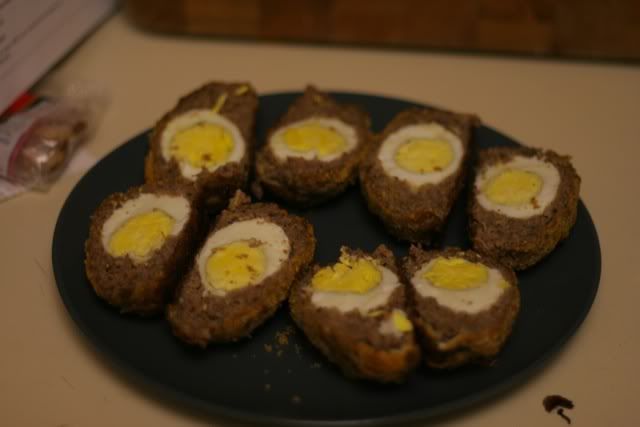 Ok, beauties may be too strong of a descriptor. I admit that I didn't make the most attractive appetizers the bar world has ever seen. Part of this stems from the hard boiled eggs. I'm just not good at them. I mean, they're easy enough to make, but I've had a terrible time getting the shells off, both here and with the deviled eggs. I even let these eggs sit in the fridge for a couple of weeks because that's what all the websites recommend, but I still had a hell of a time. I was happy to wrap these things in sausage so I didn't have to look at them anymore.
This was a unique recipe for me because it was the first time I've made one of these Achewood recipes for someone other than myself and my wife. My good friend Mike Smith (of Eros, Inc. fame) was hosting a screening of a movie on which he had a writing credit. The movie is called Humanity's End, and Mike will be one of the first to admit that it's terrible (he had very little to do with the finished product, really). As such, he encouraged drinking and I decided to bring a plate of drinking food. So, I walked into a room full of vegetarians (this is Silver Lake, people, one of the more liberal sections of LA...think about that) with a plate full of unborn baby chickens wrapped in ground up pig. I ate nearly a third of them, to "prime the engine" so to speak. Finally, some more omnivores arrived and helped me out. They were a hit! One of my friends, Chris Yule (I don't have a link for him, but he's currently the guy in the "Cash grab" booth on the E-Surance commercial, and he's incredibly funny and one of the nicest guys I know. You'd like him) had spent some time in the UK and he was thrilled to see a plate of scotch eggs. They were one of his favorites, apparently, and he told me that mine were everything a scotch egg should be. That made me very proud. I'll admit it, I cook because I like to eat, but I also enjoy people telling me how much they enjoy something I've made or seeing people who are impressed that I know how to cook at all. It's a nice feeling.
Ok, that's about it for today. New post Friday, I promise. If it's not there, you can hunt me down and slap me open-hand across the face.
Cheers,
Eli
Still, looking at Cornelius's recipe, I couldn't fathom why I wouldn't like such a thing. It's basically a delicious breakfast all rolled up in one easy-to-eat package. Mr. Bear mentions this as a traditional pub food, and I certainly would order it while out for a drink. I honestly don't know why these haven't caught on more as an American bar staple. It's a hard-boiled egg, wrapped in spicy sausage, and breaded. This is really just a step away from those KFC amalgamation bowls that America seems to love, and those require silverware! Seriously, America, let's make this happen. I don't care if you have to rename them Uncle Sam's American Eagle Eggs, we need more bars serving these little beauties:
Ok, beauties may be too strong of a descriptor. I admit that I didn't make the most attractive appetizers the bar world has ever seen. Part of this stems from the hard boiled eggs. I'm just not good at them. I mean, they're easy enough to make, but I've had a terrible time getting the shells off, both here and with the deviled eggs. I even let these eggs sit in the fridge for a couple of weeks because that's what all the websites recommend, but I still had a hell of a time. I was happy to wrap these things in sausage so I didn't have to look at them anymore.This was a unique recipe for me because it was the first time I've made one of these Achewood recipes for someone other than myself and my wife. My good friend Mike Smith (of Eros, Inc. fame) was hosting a screening of a movie on which he had a writing credit. The movie is called Humanity's End, and Mike will be one of the first to admit that it's terrible (he had very little to do with the finished product, really). As such, he encouraged drinking and I decided to bring a plate of drinking food. So, I walked into a room full of vegetarians (this is Silver Lake, people, one of the more liberal sections of LA...think about that) with a plate full of unborn baby chickens wrapped in ground up pig. I ate nearly a third of them, to "prime the engine" so to speak. Finally, some more omnivores arrived and helped me out. They were a hit! One of my friends, Chris Yule (I don't have a link for him, but he's currently the guy in the "Cash grab" booth on the E-Surance commercial, and he's incredibly funny and one of the nicest guys I know. You'd like him) had spent some time in the UK and he was thrilled to see a plate of scotch eggs. They were one of his favorites, apparently, and he told me that mine were everything a scotch egg should be. That made me very proud. I'll admit it, I cook because I like to eat, but I also enjoy people telling me how much they enjoy something I've made or seeing people who are impressed that I know how to cook at all. It's a nice feeling.
Ok, that's about it for today. New post Friday, I promise. If it's not there, you can hunt me down and slap me open-hand across the face.
Cheers,
Eli
Monday, October 26, 2009
Brined Pork Tenderloin (p. 30) with Caramelized Onions (p. 23)
What the hell? I have a blog? Aw crap, I should probably write something here. Yeah, I know it's been over a week since I posted anything. It's not that I haven't been cooking, I just haven't been writing about it. Selzer & Smuckles has continued in the real world, I just need to play catchup with my writeups. So let's not waste anymore time. This is my second foray into brining, a technique I probably wouldn't have tried if not for this project. And, well, spoiler alert - it went really, really well. Brined Pork Tenderloin is brought to us by Teodor, and so my expectations were high going in. I had this one earmarked early on as something that might be a cut above the rest of the cookbook, partly because Teodor is a renowned foodie and partly because it sounded pretty delicious.
The procedure began pretty much the same as the Ruuude Chicken. Fill a pot with water, salt, sugar and spices and throw some meat in. Thankfully, a pork loin is significantly smaller than a whole chicken, and the recipe didn't call for quite as much brine. I had a container easily large enough to hold the solution: my slow cooker crock. The recipe called for the pork to sit in the brine for anywhere from overnight to 3 days. I opted for the longer time. More time for flavor to get in. That's science, right? Anyway, the pork loin is not an attractive cut of meat. It's a sad, cheap cut that sits in a roll amongst the other, more popular cuts of a pig. When you see it sitting in a bucket of saltwater, your first thought isn't really, "I bet that thing tastes great." It's usually something more like, "Who cut off this horse penis and why are they giving it a bath?" See for yourself:
 That's basically the entire preparation for the meal. After the brining is complete, you throw it in the oven until it reads a safe temperature (160 degrees). The temperature is important with pork, unless of course you want to die. After that, it's up to the chef to make it look like something someone would willingly eat. Baking a moist meat log doesn't really give you any kind of crust, so even out of the oven you have a grayish, round hunk of pork. The Achewood Cookbook doesn't really go into presentation or serving most of its recipes, and this one basically ended with taking it out of the oven. I went with what I believe to be the standard option and cut it into medallions, about an inch thick. I stacked them in an attractive, fan-like pattern like I've seen on the TV (incidentally, I made this on "pork night" on Top Chef...yes, I'm that far behind...and I think this recipe would have fared pretty well compared to some of the losers). I must say, I'm rather proud of this one. I'm usually awful at presentation, and this at least looked decent:
 But we aren't done yet! That's right, you wait this long, you get a two-fer! The recipe said it should be served with Caramelized Onions, also by Teodor. I think most of the time I've always considered sauteed or grilled onions to be caramelized, but I knew in my heart I was wrong. Caramelization, according to Wikipedia, refers to the "oxidation of sugar" as "a type of non-enzymatic browning." The Scribe and Mouse, now with research! Anyway, the caramelization essentially boiled down to (pun intended) making a balsamic vinegar reduction with a sliced onion. The result was that great, kind of slimy texture I've come to love from a caramelized onion. The flavor was maybe a little too vinegary for my tastes, but it wasn't overpowering by any stretch and it worked with the dish. I've seen other caramelized onion recipes that call for varies wines, and I may have to try them in the future. Anyway, I topped the pork with the onions, and was ready to serve:
 You can see the side I made in the background - pan-fried red potatoes with garlic and thyme. I also put some applesauce on the plate, for tradition's sake. This was easily the best meal Achewood has provided thus far. The meat was succulent and flavorful and the onions provided a nice, contrasting sweetness and tang to the salty pork. I've always considered pork to be a salty meat, and was worried that the brine would be like overkill on the old sodium chloride. These fears were misguided. The dish was elegant and balanced, and honestly tasted like something I'd order in a restaurant. Melissa doesn't usually eat pork (not a religious thing, she just doesn't like it much) and she gobbled this up. She absolutely loved it (I may have turned a corner with her and pork; we'll see). I couldn't blame her. The ate every bite on my plate and still wanted more. This is the kind of thing I expect from Teodor - classy food that's a step above the "open can and heat" mentality of some of the rest of the Achewood Cookbook. It was a fantastic meal, the kind we don't always get at home. Our nightly dinners have a tendency to blend together as we consume foods that we consider "favorites" or "easy to prepare" or "not bad for cheap." And that's fine. If we didn't have mundane dinners, quality like this wouldn't stand out so much. It made a Wednesday night in front of the TV feel like a special occasion.
Ok, that's it for today. I'll be back soon (I promise) with more tales of the kitchen.
Cheers,
Eli
The procedure began pretty much the same as the Ruuude Chicken. Fill a pot with water, salt, sugar and spices and throw some meat in. Thankfully, a pork loin is significantly smaller than a whole chicken, and the recipe didn't call for quite as much brine. I had a container easily large enough to hold the solution: my slow cooker crock. The recipe called for the pork to sit in the brine for anywhere from overnight to 3 days. I opted for the longer time. More time for flavor to get in. That's science, right? Anyway, the pork loin is not an attractive cut of meat. It's a sad, cheap cut that sits in a roll amongst the other, more popular cuts of a pig. When you see it sitting in a bucket of saltwater, your first thought isn't really, "I bet that thing tastes great." It's usually something more like, "Who cut off this horse penis and why are they giving it a bath?" See for yourself:
That's basically the entire preparation for the meal. After the brining is complete, you throw it in the oven until it reads a safe temperature (160 degrees). The temperature is important with pork, unless of course you want to die. After that, it's up to the chef to make it look like something someone would willingly eat. Baking a moist meat log doesn't really give you any kind of crust, so even out of the oven you have a grayish, round hunk of pork. The Achewood Cookbook doesn't really go into presentation or serving most of its recipes, and this one basically ended with taking it out of the oven. I went with what I believe to be the standard option and cut it into medallions, about an inch thick. I stacked them in an attractive, fan-like pattern like I've seen on the TV (incidentally, I made this on "pork night" on Top Chef...yes, I'm that far behind...and I think this recipe would have fared pretty well compared to some of the losers). I must say, I'm rather proud of this one. I'm usually awful at presentation, and this at least looked decent:But we aren't done yet! That's right, you wait this long, you get a two-fer! The recipe said it should be served with Caramelized Onions, also by Teodor. I think most of the time I've always considered sauteed or grilled onions to be caramelized, but I knew in my heart I was wrong. Caramelization, according to Wikipedia, refers to the "oxidation of sugar" as "a type of non-enzymatic browning." The Scribe and Mouse, now with research! Anyway, the caramelization essentially boiled down to (pun intended) making a balsamic vinegar reduction with a sliced onion. The result was that great, kind of slimy texture I've come to love from a caramelized onion. The flavor was maybe a little too vinegary for my tastes, but it wasn't overpowering by any stretch and it worked with the dish. I've seen other caramelized onion recipes that call for varies wines, and I may have to try them in the future. Anyway, I topped the pork with the onions, and was ready to serve:You can see the side I made in the background - pan-fried red potatoes with garlic and thyme. I also put some applesauce on the plate, for tradition's sake. This was easily the best meal Achewood has provided thus far. The meat was succulent and flavorful and the onions provided a nice, contrasting sweetness and tang to the salty pork. I've always considered pork to be a salty meat, and was worried that the brine would be like overkill on the old sodium chloride. These fears were misguided. The dish was elegant and balanced, and honestly tasted like something I'd order in a restaurant. Melissa doesn't usually eat pork (not a religious thing, she just doesn't like it much) and she gobbled this up. She absolutely loved it (I may have turned a corner with her and pork; we'll see). I couldn't blame her. The ate every bite on my plate and still wanted more. This is the kind of thing I expect from Teodor - classy food that's a step above the "open can and heat" mentality of some of the rest of the Achewood Cookbook. It was a fantastic meal, the kind we don't always get at home. Our nightly dinners have a tendency to blend together as we consume foods that we consider "favorites" or "easy to prepare" or "not bad for cheap." And that's fine. If we didn't have mundane dinners, quality like this wouldn't stand out so much. It made a Wednesday night in front of the TV feel like a special occasion.Ok, that's it for today. I'll be back soon (I promise) with more tales of the kitchen.
Cheers,
Eli
Friday, October 16, 2009
Chef Ray's No-Butter, No-Fry Hot Wings! (Insert)
Ok, this recipe isn't truly a part of the cookbook. I got this one for ordering the (now apparently defunct) cook's gift set from Achewood. It included the book, an apron, and the item that turned out to be the main ingredient for today's dish: Ray's Rad Chilies Hot Sauce:
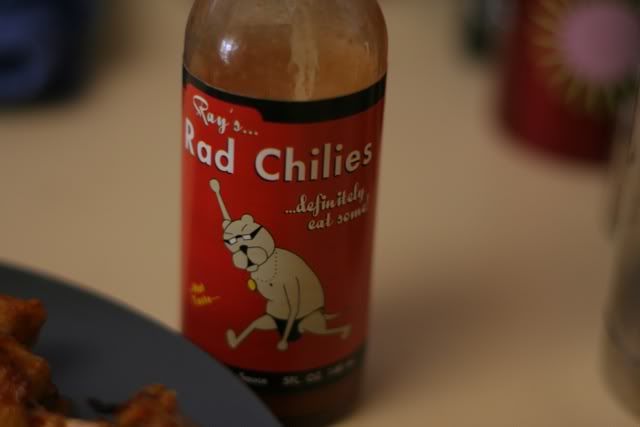 So what is a rad chili, you may ask? Well, to put it bluntly, it is an invented slang word for a man (or cartoon cat)'s junk. In an alternate version of an early strip, Ray is being advised on how to treat a lady. Ray's question in this alternate version is "Can I still call my junk my rad chilies?" The phrase sort of took off from there. It's also the name of my fantasy football team. As an aside, in case I haven't explained who Ray is well enough, I think this picture on the side of the bottle sums him up rather succinctly.
 If you can't read that, it says, "Every Weekday." This is how I like to picture Ray's weekdays (and any wealthy man of leisure, for that matter): Playing saxophone on the pier in a thong and a captains hat. Class.
Today's recipe is pretty much what its title implies: No butter, no fry hot wings. My family makes something similar to this; we call them Flood Wings. I'm not positive where the name comes from, but I've always assumed that they were first made during the big Iowa floods of 1993 and the name just stuck. I'm sure my parents will correct me in the comments if I'm wrong. I've never made them myself, but they're very popular at family gatherings. They bake in the oven and are a nice change from the deep fried treat guzzled at tailgating parties like potato chips. They have a nice, smoky teriyaki flavor without letting you forget that you're eating wings. As I start to cook more, I've been fascinated by the chicken wing. When you make a whole bird, you're usually told to throw it away. What entrepreneur had the rad chilies to say, "Don't throw them out, give them to me! I'll pretend they're desirable and sell them for millions!" ? Amazing.
Anyway, Ray's wings aren't entirely like flood wings. I have a feeling the method is similar, but the sauce is different. In this case, instead of whatever teriyaki my parents use, Ray uses his rad chilies sauce. You coat both sides and then coat them once or twice more during cooking. The real innovation here for me was what the recipe calls "lollipopping." The recipe only uses drumettes (and I agree that the other kind of wing is a pain in the ass), and you snip the meat at the thin end and push it towards the fat end. This creates a very convenient handle, virtually eliminating the mess. Observe:
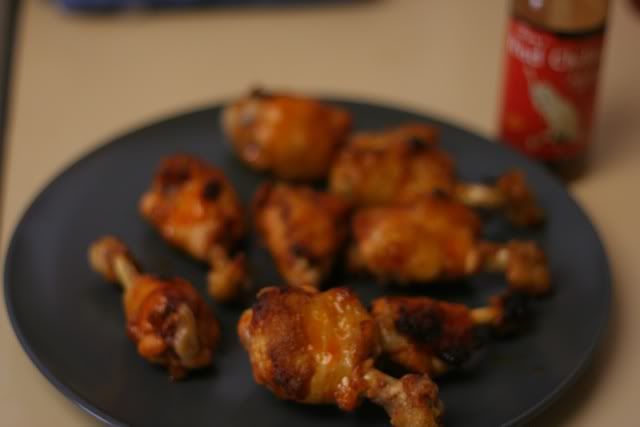 I made these, grabbed a beer, and turned on football. It felt right. It felt natural. Ray's hot sauce is very flavorful. It may just be from one of those places that makes generic hot sauces and slaps labels on it, but it didn't really taste like it. Maybe I was distracted by the "Every Weekday" saxophone. It was a solid winner of a recipe that managed to be new while still reminding me both of my home and a favorite junk food. The only downside is that I ended up using about half of the bottle of hot sauce. The stuff isn't that cheap (including shipping), and you can only order it online. And now there's a recipe that uses most of the bottle? I smell a scam, Onstad. I want to make these in a larger batch for a party sometime, but I have to imagine I'll use a cheaper hot sauce that I can buy in bulk (as the recipe calls it, a "lesser-quality hot sauce"). It may not be exactly the same, but I doubt most people would even notice. They'd just be impressed that I turned on the oven instead of ordering wings from Pizza Hut. Most people are easily impressed. I'm rambling. Good night.
Cheers,
Eli
So what is a rad chili, you may ask? Well, to put it bluntly, it is an invented slang word for a man (or cartoon cat)'s junk. In an alternate version of an early strip, Ray is being advised on how to treat a lady. Ray's question in this alternate version is "Can I still call my junk my rad chilies?" The phrase sort of took off from there. It's also the name of my fantasy football team. As an aside, in case I haven't explained who Ray is well enough, I think this picture on the side of the bottle sums him up rather succinctly.If you can't read that, it says, "Every Weekday." This is how I like to picture Ray's weekdays (and any wealthy man of leisure, for that matter): Playing saxophone on the pier in a thong and a captains hat. Class.Today's recipe is pretty much what its title implies: No butter, no fry hot wings. My family makes something similar to this; we call them Flood Wings. I'm not positive where the name comes from, but I've always assumed that they were first made during the big Iowa floods of 1993 and the name just stuck. I'm sure my parents will correct me in the comments if I'm wrong. I've never made them myself, but they're very popular at family gatherings. They bake in the oven and are a nice change from the deep fried treat guzzled at tailgating parties like potato chips. They have a nice, smoky teriyaki flavor without letting you forget that you're eating wings. As I start to cook more, I've been fascinated by the chicken wing. When you make a whole bird, you're usually told to throw it away. What entrepreneur had the rad chilies to say, "Don't throw them out, give them to me! I'll pretend they're desirable and sell them for millions!" ? Amazing.
Anyway, Ray's wings aren't entirely like flood wings. I have a feeling the method is similar, but the sauce is different. In this case, instead of whatever teriyaki my parents use, Ray uses his rad chilies sauce. You coat both sides and then coat them once or twice more during cooking. The real innovation here for me was what the recipe calls "lollipopping." The recipe only uses drumettes (and I agree that the other kind of wing is a pain in the ass), and you snip the meat at the thin end and push it towards the fat end. This creates a very convenient handle, virtually eliminating the mess. Observe:
I made these, grabbed a beer, and turned on football. It felt right. It felt natural. Ray's hot sauce is very flavorful. It may just be from one of those places that makes generic hot sauces and slaps labels on it, but it didn't really taste like it. Maybe I was distracted by the "Every Weekday" saxophone. It was a solid winner of a recipe that managed to be new while still reminding me both of my home and a favorite junk food. The only downside is that I ended up using about half of the bottle of hot sauce. The stuff isn't that cheap (including shipping), and you can only order it online. And now there's a recipe that uses most of the bottle? I smell a scam, Onstad. I want to make these in a larger batch for a party sometime, but I have to imagine I'll use a cheaper hot sauce that I can buy in bulk (as the recipe calls it, a "lesser-quality hot sauce"). It may not be exactly the same, but I doubt most people would even notice. They'd just be impressed that I turned on the oven instead of ordering wings from Pizza Hut. Most people are easily impressed. I'm rambling. Good night.Cheers,
Eli
Wednesday, October 14, 2009
Omega Potato (p. 40)
This is another one of Achewood's incredibly basic recipes. Do you know how to bake a potato? Of course you do. You don't need a book to tell you how to do it. And yet, I have to remember the key demographic for this cookbook- grown men who still wear baseball caps backwards and have Al Pacino posters on their walls, unframed. I suppose even the best of us (not that I think of myself as "the best") could use a refresher. And Pat's Omega Potato method is a little different from what I normally do, so what the hell?
The recipe calls for a hotter oven than I usually use, and a longer cooking time. Naturally, I was concerned about burning after the "Perfect Oven Fries" incident, but that wasn't the case this time. The real concern for me was that I wasn't supposed to do anything to the potato before putting it in the oven (aside from scrubbing, of course). I normally coat with olive oil and salt before cooking, and I also poke holes in the sides to prevent explosions. And that's where I had to draw the line. Pat specifically states not to do ANYTHING, including poking ventilation holes. I did a little research while the oven was preheating. There were several stories and message board comments that read, "I've cooked potatoes in the oven without poking holes for years without incident." Of course, the next sentence was invariably, "Until last night when a potato exploded, killing my wife and children" (ok, maybe it just made a mess of the oven, whatever). So, I made an executive decision and poked holes in the potato anyway. My oven's crappy enough without being caked in potato bits. An hour and a half at 500 degrees later, I had my potato.
 I should start out by saying that there's not nearly as much of the dill and sour cream sauce as it looks like there is on that plate. It's a very thin spread, I was trying to be creative. The potato had what could almost be described as two skins. There's the outer skin, which was like I've had on every potato (maybe a little crunchier), and then there was a tougher inner skin. When I cut into it, I was afraid it felt incredibly tough and dry. I was surprised and delighted to find myself wrong. The starch inside was light and fluffy. I normally like butter and sour cream in my BPs (that's what the kids on the street call baked potatoes), but Pat's recipe recommended a few glugs of olive oil, so that's what I did. The flavor was nice, though I did end up putting a little sour cream in there, too. The bigger issue was that the crunchy skin of the potato was also apparently quite porous on the bottom. Within 5 minutes, I had a large puddle of olive oil under the potato. It eventually seeped all over the plate, getting on my salmon and mixing into the dill sauce. It didn't detract from the potato, but the potato is just a side and it did detract from the dish. Live and learn. So, nothing too difficuly, but I suppose there are people who could use a refresher on where babies and baked potatoes come from. It doesn't have to be fancy to be fun.
Cheers,
Eli
The recipe calls for a hotter oven than I usually use, and a longer cooking time. Naturally, I was concerned about burning after the "Perfect Oven Fries" incident, but that wasn't the case this time. The real concern for me was that I wasn't supposed to do anything to the potato before putting it in the oven (aside from scrubbing, of course). I normally coat with olive oil and salt before cooking, and I also poke holes in the sides to prevent explosions. And that's where I had to draw the line. Pat specifically states not to do ANYTHING, including poking ventilation holes. I did a little research while the oven was preheating. There were several stories and message board comments that read, "I've cooked potatoes in the oven without poking holes for years without incident." Of course, the next sentence was invariably, "Until last night when a potato exploded, killing my wife and children" (ok, maybe it just made a mess of the oven, whatever). So, I made an executive decision and poked holes in the potato anyway. My oven's crappy enough without being caked in potato bits. An hour and a half at 500 degrees later, I had my potato.
I should start out by saying that there's not nearly as much of the dill and sour cream sauce as it looks like there is on that plate. It's a very thin spread, I was trying to be creative. The potato had what could almost be described as two skins. There's the outer skin, which was like I've had on every potato (maybe a little crunchier), and then there was a tougher inner skin. When I cut into it, I was afraid it felt incredibly tough and dry. I was surprised and delighted to find myself wrong. The starch inside was light and fluffy. I normally like butter and sour cream in my BPs (that's what the kids on the street call baked potatoes), but Pat's recipe recommended a few glugs of olive oil, so that's what I did. The flavor was nice, though I did end up putting a little sour cream in there, too. The bigger issue was that the crunchy skin of the potato was also apparently quite porous on the bottom. Within 5 minutes, I had a large puddle of olive oil under the potato. It eventually seeped all over the plate, getting on my salmon and mixing into the dill sauce. It didn't detract from the potato, but the potato is just a side and it did detract from the dish. Live and learn. So, nothing too difficuly, but I suppose there are people who could use a refresher on where babies and baked potatoes come from. It doesn't have to be fancy to be fun.Cheers,
Eli
Friday, October 9, 2009
Ruuude Chicken (p. 24)
Welcome to the wonderful world of brining! While I'm sure I've eaten brined food in the past (it seems like something my dad would do, and he's cooked a lot of awesome meals for me in the past), it's my first time doing it myself. It seems pretty easy on paper- 2 gallons of water, salt, sugar, and spices. In real life...well, it was pretty easy there, too. The only problem I had was that I didn't have a pot, bucket, or any kind of container that could hold 2 gallons of water. One of those things I probably should have checked before I went out shopping. Oh well, I made it work (yes, I just watched Project Runway. My wife likes it. Shut up). Anyway, I went to buy a free range, organic chicken like Ray's recipe told me to, but that business was, like, $13 for a 4 pound bird at Trader Joe's. I won't be getting paid from the new job for two weeks, so I decided I could do better at Ralph's. Now, for those of you not from California, Ralph's is a big supermarket. Think Kroger if you're in the South (same parent company) or Hy-Vee in the Midwest. I'm sure other parts of the country have supermarkets, too. Anyway, you would expect your supermarket to have more than 2 whole chickens for sale in the whole store. If you were me, you would be wrong. Ralph's had 2 three pound fryers in the produce section and not even anything frozen. I even asked a person if there was some place I wasn't looking (if you know me, you know this is a big deal for me). Nope. I settled for the 3 pounder, grumbling all the way (though for $5, it's hard to argue with the price). Just so Ralph's doesn't look terrible, I did save a fortune on cloves by buying them in the Mexican bagged spice aisle instead of the spice jar aisle. $10 for a jar, 69 cents for a bag with about the same amount. But I digress.
Using the smaller bird, I was content to make less brine. I filled my stock pot up with 1.75 gallons of water and cut the spices by the same ratio (maths!). Then I put the chicken in and watched even more water flow out of the pot. Oh well, at least the mixture was the right amounts. I covered it and put it in the fridge overnight, because, as the recipe says, "The greatest talent of a chicken is to unleash death if not kept at the proper low temperatures prior to cooking."
 This is another hilariously written recipe. All of Ray's entries in the books are written in a very colorful stream of consciousness that can make it hard to actually follow the recipe, but makes it much more entertaining to read. I guess that's so if the recipes turn out terrible, you at least feel like you got your money's worth. Plus, if you're going to make a cookbook based on a webcomic, it makes sense to make it funny. Thankfully, this one didn't turn out terrible.
 The meat was nice and moist and stayed that way for three days in the fridge. That's no small feat; chicken has a real tendency to dry out in the fridge and just be horrible a day or two later. I even enjoyed the skin, even if the recipe says it's, "hella bad for you," and, "might not be so rad." I wouldn't call it "rad," exactly, but it was certainly edible. Still, the dish suffered from one critical flaw- it was chicken. I mentioned it with the Beer Can Chicken, but I have yet to find a chicken recipe that ended up tasting like anything other than chicken. Not that that's a bad thing, really, it's just that you always know what to expect with chicken, you can't be surprised. Maybe that's ok for some people, but I like a little mystery on a menu. I like to taste something I've never tasted before, or at least something I have tasted presented in a way that catches me off guard. I can't imagine ordering chicken at a fancy restaurant because there's really no way it will blow my mind. I can't picture anything that Emerils or Batalis of the world could do with a chicken that would make it taste that different from what I do in my apartment. Maybe Wylie Dufresne and the molecular gastronomists could do something different, but to me, chicken is a "white bread" white meat. The difference between fried, grilled, and baked chicken is really just a matter of texture. Get past the outer layer and it's plain old poultry. I'd love for someone to prove me wrong. Consider that a challenge.
Cheers,
Eli
Using the smaller bird, I was content to make less brine. I filled my stock pot up with 1.75 gallons of water and cut the spices by the same ratio (maths!). Then I put the chicken in and watched even more water flow out of the pot. Oh well, at least the mixture was the right amounts. I covered it and put it in the fridge overnight, because, as the recipe says, "The greatest talent of a chicken is to unleash death if not kept at the proper low temperatures prior to cooking."
This is another hilariously written recipe. All of Ray's entries in the books are written in a very colorful stream of consciousness that can make it hard to actually follow the recipe, but makes it much more entertaining to read. I guess that's so if the recipes turn out terrible, you at least feel like you got your money's worth. Plus, if you're going to make a cookbook based on a webcomic, it makes sense to make it funny. Thankfully, this one didn't turn out terrible.The meat was nice and moist and stayed that way for three days in the fridge. That's no small feat; chicken has a real tendency to dry out in the fridge and just be horrible a day or two later. I even enjoyed the skin, even if the recipe says it's, "hella bad for you," and, "might not be so rad." I wouldn't call it "rad," exactly, but it was certainly edible. Still, the dish suffered from one critical flaw- it was chicken. I mentioned it with the Beer Can Chicken, but I have yet to find a chicken recipe that ended up tasting like anything other than chicken. Not that that's a bad thing, really, it's just that you always know what to expect with chicken, you can't be surprised. Maybe that's ok for some people, but I like a little mystery on a menu. I like to taste something I've never tasted before, or at least something I have tasted presented in a way that catches me off guard. I can't imagine ordering chicken at a fancy restaurant because there's really no way it will blow my mind. I can't picture anything that Emerils or Batalis of the world could do with a chicken that would make it taste that different from what I do in my apartment. Maybe Wylie Dufresne and the molecular gastronomists could do something different, but to me, chicken is a "white bread" white meat. The difference between fried, grilled, and baked chicken is really just a matter of texture. Get past the outer layer and it's plain old poultry. I'd love for someone to prove me wrong. Consider that a challenge.Cheers,
Eli
Wednesday, October 7, 2009
Five Dollar Chili (p.35)
I normally don't like to make chili during the summer. Melissa has no such scruples. She loves a spicy, meaty soup any time of the year. Still, I was glad that by the time I got around to making Roast Beef's Five Dollar Chili, the temperature had dropped into the 50s at night in LA. Cool enough for me. This is not to say I didn't have some trepidation about making this chili. When I bought the cookbook, Chris Onstad was still willing to personalize it with a sketch and signature. This is what mine looked like:
 In case you can't read that, Roast Beef is telling me, "Don't make the chili" (by the way, I was thrilled that my personalized drawing was Roast Beef). My assumption is that this has something to do with the fact that chili makes you gassy. I support my assumption with the fact that my wife ordered this as a gift and the recipe starts with the line, "This recipe is basically for a man who is alone in his life." Well, I make my own chili quite a lot, so our apartment is no stranger to farting. We're cool with it. Melissa wasn't going to let a little gas stand in the way of a chili.
To start, despite what the recipe says, I wasn't not able to make this chili for five dollars. I spent more than that on the stew meat. Granted, I bought organic, free range beef instead of the cheap stuff, but I priced the plain-Jane beef cubes out at the regular store and I still doubt I could make the chili for five bucks. Beef just ain't that cheap. Still, it certainly didn't break the bank, especially since it made enough for two or three meals. I had never used stew meat cubes in making a chili before. My recipe calls for ground beef (I often use turkey- you can't taste a different, what you taste is the beans and spices). So really, this was a whole different animal.
 But at the end of the day, chili is pretty much chili. It was very tasty, but not shockingly different from the stuff I regularly make. I usually cook in a slow cooker, but I could cook it in a put just as well. The real difference was in the texture. Even though the beef flaked easily (think a pulled pork barbecue sandwich), it was a little harder to eat with a spoon than ground beef. A large cube just takes up too much spoon real estate, whereas ground meat blends nicely into a soup. This chili also only used one can of beans, while my recipe uses at least three. The gravy that beans sit in inside the can almost certainly adds more liquid to the mix than what I found in my pot. As a result, the Achewood chili came out thicker than my usual fare. This wasn't a bad thing, it just reminded me of the kind of chili you can buy in a can (which I use to make chili dogs). I wonder if that's the intention of Roast Beef's chili- to use as a topping. He does list several meal possibilities at the end (eggs, rice, etc). I imagine it would me good on spaghetti in a classic Cincinnati chili. I guess I just expect a more soupy quality when I make chili. Like I said, this wasn't a knock on the recipe. It was delicious, and I enjoyed finishing it over the course of a couple of days.
And the farting? Well, no more than any other day in the Selzer Apartment. I apologize if that offends you; you shouldn't have asked. What's that? You didn't? Oh right, I just offered it freely. Sorry about that.
Cheers,
Eli
In case you can't read that, Roast Beef is telling me, "Don't make the chili" (by the way, I was thrilled that my personalized drawing was Roast Beef). My assumption is that this has something to do with the fact that chili makes you gassy. I support my assumption with the fact that my wife ordered this as a gift and the recipe starts with the line, "This recipe is basically for a man who is alone in his life." Well, I make my own chili quite a lot, so our apartment is no stranger to farting. We're cool with it. Melissa wasn't going to let a little gas stand in the way of a chili.To start, despite what the recipe says, I wasn't not able to make this chili for five dollars. I spent more than that on the stew meat. Granted, I bought organic, free range beef instead of the cheap stuff, but I priced the plain-Jane beef cubes out at the regular store and I still doubt I could make the chili for five bucks. Beef just ain't that cheap. Still, it certainly didn't break the bank, especially since it made enough for two or three meals. I had never used stew meat cubes in making a chili before. My recipe calls for ground beef (I often use turkey- you can't taste a different, what you taste is the beans and spices). So really, this was a whole different animal.
But at the end of the day, chili is pretty much chili. It was very tasty, but not shockingly different from the stuff I regularly make. I usually cook in a slow cooker, but I could cook it in a put just as well. The real difference was in the texture. Even though the beef flaked easily (think a pulled pork barbecue sandwich), it was a little harder to eat with a spoon than ground beef. A large cube just takes up too much spoon real estate, whereas ground meat blends nicely into a soup. This chili also only used one can of beans, while my recipe uses at least three. The gravy that beans sit in inside the can almost certainly adds more liquid to the mix than what I found in my pot. As a result, the Achewood chili came out thicker than my usual fare. This wasn't a bad thing, it just reminded me of the kind of chili you can buy in a can (which I use to make chili dogs). I wonder if that's the intention of Roast Beef's chili- to use as a topping. He does list several meal possibilities at the end (eggs, rice, etc). I imagine it would me good on spaghetti in a classic Cincinnati chili. I guess I just expect a more soupy quality when I make chili. Like I said, this wasn't a knock on the recipe. It was delicious, and I enjoyed finishing it over the course of a couple of days.And the farting? Well, no more than any other day in the Selzer Apartment. I apologize if that offends you; you shouldn't have asked. What's that? You didn't? Oh right, I just offered it freely. Sorry about that.
Cheers,
Eli
Tuesday, October 6, 2009
Vegetables Delight (p. 16)
Almost every writeup I see of the Achewood Cookbook mentions that it includes a fake recipe. Chris Onstad's forward blatantly states that one of the recipes is impossible. I believe I have found that recipe in Ray's Vegetables Delight. See, the conceit of the book is that Chris is paying his characters to provide recipes for the project. Ray apparently was assigned something called Vegetables Delight. Why you wouldn't give this recipe to Pat, the Vegan, I don't know. Ray sure isn't happy about it. In fact, 95% of this "recipe" is Ray complaining about how terrible vegetables are. He's angry at the recipe, angry about Chinese restaurants that serve things called "Vegetables Delight," and mad at you, the reader, for having to explain what a vegetable is. I hope Mr. Onstad won't mind that I'm going to post the actual cooking portion of this recipe in its entirety, just so you get what I'm dealing with:
"Peel five carrots and microwave them for ten minutes OKAY I'M DONE GOODBYE"
 Yep, I made it anyway. I'm that committed to this project. And that is what carrots look like after sitting in the microwave for ten minutes. They were a strange amalgam of moisture and dryness. The texture was downright disturbing. It kind of felt like a mushy potato with a very thick skin, but if feeling them blind you'd probably think it was some kind of eviscerated internal organ. The tough, dry exterior (after much chewing and gnawing) yielded to a molten mush of baby food-style carrot innards. I took one bite and was still trying to finish swallowing five minutes later. The rest went straight into the trash. I'm committed, but not that committed. These carrots cost me 67 cents. That's 67 cents I will never see again. If we come up 67 cents short of being able to afford rent this month, I expect Achewood to provide me with a new apartment.
Cheers,
Eli
"Peel five carrots and microwave them for ten minutes OKAY I'M DONE GOODBYE"
Yep, I made it anyway. I'm that committed to this project. And that is what carrots look like after sitting in the microwave for ten minutes. They were a strange amalgam of moisture and dryness. The texture was downright disturbing. It kind of felt like a mushy potato with a very thick skin, but if feeling them blind you'd probably think it was some kind of eviscerated internal organ. The tough, dry exterior (after much chewing and gnawing) yielded to a molten mush of baby food-style carrot innards. I took one bite and was still trying to finish swallowing five minutes later. The rest went straight into the trash. I'm committed, but not that committed. These carrots cost me 67 cents. That's 67 cents I will never see again. If we come up 67 cents short of being able to afford rent this month, I expect Achewood to provide me with a new apartment.Cheers,
Eli
Saturday, October 3, 2009
Microwave Egg Muffin (p. 34)
Hello, and welcome back to Selzer and Smuckles! I'm back from vacation and ready to get back to cooking. We start off with a Microwave Egg Muffin. Since I'm out of work for the next couple of weeks (don't worry, the new job is lined up), I have more time to make breakfast in the morning. Thus, I don't always have to have cereal (though Target is selling Count Chocula, Frankenberry, and Boo Berry for $1.99 so cereal's not so bad). This recipe comes to us from Lyle, his only contribution to the book aside from his forward. Lyle's kind of a dirtbag. He once puked so hard it made a football go three feet. He's never without a bottle of Jack, he's got that mustache that only other people with mustaches like, and he cares way more than a person (or cartoon tiger) should about cars. Every once in a while we get to see a more sensitive, thoughtful side of Lyle, but it never lasts; he'll be swearing and fighting again by the end of the strip. Still, as he mentions in his forward, he's worked in a ton of restaurants over the years (and don't kid yourself, this is pretty much exactly the kind of person that every restaurant has working in the kitchen, from Applebee's to a Michelin rated fancy pants hideout). His advice is sound (creating a mise-en-place, (ie. getting ingredients ready before you start), don't be afraid of heat, experiment, etc.) and you feel like you can trust him, even if he does seem like the kind of guy who is probably going to give you a recipe you can make with things you find on the floor.
 The microwave egg muffin is clearly similar to the McDonald's Egg McMuffin (he said in the recipe that ham was optional, so I didn't use any. I won't get another paycheck for a while, you know). I've always been more off a Bacon, Egg, and Cheese biscuit guy at the fast food breakfast counter, but who doesn't like an egg muffin once in a while? And this really couldn't be easier. Put some egg whites in a bowl, season them, and microwave. Once they're set, throw on a slice of cheese and microwave a bit more. Slide on to an English muffin. Done. I could make this even on a busy morning, and I probably will. It was a nice change from the norm, and was more flavorful and fluffy than an egg cooked in a microwave really has a right to be. The only complaint I had was that it was hard to clean the ramekin I used to cook the egg. Maybe I'll spray it with a little olive oil before I start next time. Probably couldn't hurt. On a side note, it was nice to use my ramekins for something other than holding salsa for once. I probably bought them to make creme brulee, but never bought the blowtorch. I will say this: they do a fine job of holding salsa.
So, that's about it. A very nice recipe from Lyle, even if it feels a little low brow (microwave cooking, and all that). It just goes to show you shouldn't judge a book by it's cover. That guy pissing into an empty beer bottle behind the alley might make the best tuna tartare you've ever tasted. Just hope he washes his hands first (even if he probably doesn't). I've got a couple more recipes all lined up and should be able to post tomorrow or Monday. Until then,
Cheers,
Eli
The microwave egg muffin is clearly similar to the McDonald's Egg McMuffin (he said in the recipe that ham was optional, so I didn't use any. I won't get another paycheck for a while, you know). I've always been more off a Bacon, Egg, and Cheese biscuit guy at the fast food breakfast counter, but who doesn't like an egg muffin once in a while? And this really couldn't be easier. Put some egg whites in a bowl, season them, and microwave. Once they're set, throw on a slice of cheese and microwave a bit more. Slide on to an English muffin. Done. I could make this even on a busy morning, and I probably will. It was a nice change from the norm, and was more flavorful and fluffy than an egg cooked in a microwave really has a right to be. The only complaint I had was that it was hard to clean the ramekin I used to cook the egg. Maybe I'll spray it with a little olive oil before I start next time. Probably couldn't hurt. On a side note, it was nice to use my ramekins for something other than holding salsa for once. I probably bought them to make creme brulee, but never bought the blowtorch. I will say this: they do a fine job of holding salsa. So, that's about it. A very nice recipe from Lyle, even if it feels a little low brow (microwave cooking, and all that). It just goes to show you shouldn't judge a book by it's cover. That guy pissing into an empty beer bottle behind the alley might make the best tuna tartare you've ever tasted. Just hope he washes his hands first (even if he probably doesn't). I've got a couple more recipes all lined up and should be able to post tomorrow or Monday. Until then,
Cheers,
Eli
Monday, September 14, 2009
Smoked Salmon on Potato Coins (p.15) and Perfect Deviled Eggs Every Time (p.14)
I apologize for the length of time between my previous post and this one, I've been extremely busy. I also apologize in advance for the upcoming length of time between this post and the next one (see bottom paragraph). Anyway, on to the food:
We decided to have an appetizer night again, since so many of the recipes in the Achewood Cookbook are best served as sides or hors d'oeuvres. We started with one of my very favorite things to eat, Perfect Deviled Eggs Every Time, brought to us by Roast Beef (who is living once again in the comic strip, in case you were worried). It seems like around my family, we only had deviled eggs around Easter and Christmas (or Thanksgiving if we were real lucky), but I see no reason why they should not be enjoyed year round. Sure they make me gassy, but that's a small price to pay for a rich, eggy treat. I can't tell you how excited I was to give this one a try.
Well, maybe I should have tempered my enthusiasm just a hair. I can tell you for certain that this is not how deviled eggs usually look:
 Maybe I can pull a Top Chef kind of trick and just say I made "deconstructed" deviled eggs. I'm not sure what that means exactly, but it sounds better than "failed" deviled eggs. Don't get me wrong, they still tasted pretty good. But the runny filling was an unappetizing texture and made them messier than a pop in your mouth treat should be. There were problems from the start. First, most of the eggs didn't peel very well. From research, I've found that I likely used eggs that were too fresh. Older eggs peel easier because of something about the albumen. I don't know. I stopped reading when it got too sciency (full disclosure- this is a lie, I'm a big science nerd and the science of cook fascinates me).
I think the one problem with the flavor is a hint to why the filling came out so wrong - Vinegar. I did a little more research and found that most recipes call for about 1 tsp of the acidic stuff. This recipe called for 3 TBSP. That's a pretty big difference, not to mention an equal parts mayonnaise (I didn't say "mayo" because Roast Beef says he hates when people do that) to vinegar ratio. I tossed some paprika on (the recipe says you only should do this if you're rich, but I had some laying around- with a large shake lid, if you notice the sloppy plating in the picture) and served them anyway. Melissa's not a huge deviled egg fan, anyway (she is wrong), so I ended up eating most of them. They tasted pretty decent and I didn't get sick, so I can't call it a total failure, just disappointing. Thankfully, the next course made up for it.
The Smoked Salmon on Potato Coins was a perfect recipe from Mr. Bear. It was classy without being pretentious, and flavorful without being overpowering. In short, it was everything an hors d'oeuvres should be. The kind of thing that a man has perfected over years of experience and feels confident serving at an elegant affair.
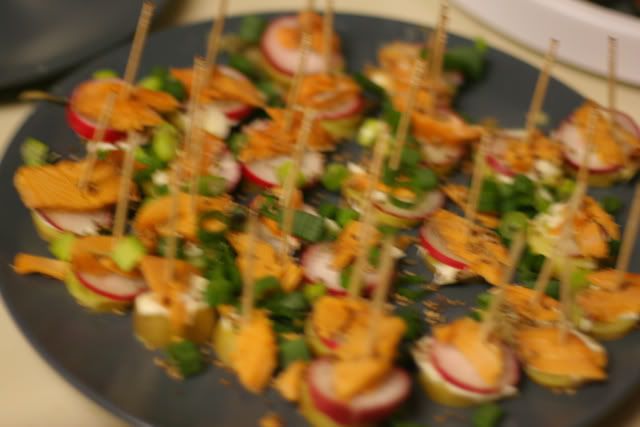 I apologize for the blurry picture. By the time I realized it hadn't come out, the food was gone. Speaking of the picture, I really need to work on my plating (though in my defense, it was late and had been a frustrating night of cooking). I happened to have some smoked salmon on hand. My friends Josh and Aubrey had brought it back from their trip to Canada last year (or maybe longer ago, I don't remember exactly). Some of you may be thinking that I'm insane to eat salmon that old, but this stuff was smoked and vacuum sealed. Those little pouches can last 10 years or more on the shelf, at least according to the package. It tasted wonderful and smokey and I still haven't died, so I have to believe that the package was right.
The base of these are little coins of fingerling potatoes, spread with mascarpone cheese. It was a little difficult spreading the cheese onto the soft potatoes, but I think most of them turned out ok. The recipe called for the salmon to be folded, which just wasn't possible with the stuff I had, so I just used the chunks as they fell (it was kind of dry and crumbly, but not in a bad way). The toasted sesame seeds and scallions were a very nice touch. They were hard to keep on the appetizers themselves, but any one that had a green onion slice or two on it was a real delight. A bit of a hassle to build, but altogether worth it, I'd say. If you come over for a cocktail party or fancy dinner fete, don't be surprised if I serve something like this.
I had intended to use a couple of left over hard boiled eggs to make Scotch Eggs (another of Mr. Bear's recipes) but at this point it was almost 9pm and I was tired of being in the kitchen. I tossed the eggs in the fridge and decided to move it to this week. As of this morning, the eggs weren't looking so good, so I'll probably have to throw them out and try again later. And by later, I mean in a couple of weeks.
See, Melissa and I leave for Orlando on Friday. We'll be at Disney World for a full week, and thus not cooking. And this week, with all of the vacation preparation, I didn't feel like doing much in the kitchen, so our dinners are all stupidly simple. Open pot, boil water, make pasta, microwave sauce. That kind of thing. Unfortunately, I seem to have exhausted the simple recipes Achewood has to offer. I just don't have time to make a brined pork chop this week (though I am going to make The Dogg Is Home again, or a slight variation of it). So, Selzer & Smuckles is going on a two week hiatus. I'll probably have a couple of blog posts, but they'll be about Disney or running or such things, not cooking from a humorous cookbook. So, take a break, read over my archives, fall in love with my blog again. Don't worry, it loves you back. Until next time,
Cheers,
Eli
We decided to have an appetizer night again, since so many of the recipes in the Achewood Cookbook are best served as sides or hors d'oeuvres. We started with one of my very favorite things to eat, Perfect Deviled Eggs Every Time, brought to us by Roast Beef (who is living once again in the comic strip, in case you were worried). It seems like around my family, we only had deviled eggs around Easter and Christmas (or Thanksgiving if we were real lucky), but I see no reason why they should not be enjoyed year round. Sure they make me gassy, but that's a small price to pay for a rich, eggy treat. I can't tell you how excited I was to give this one a try.
Well, maybe I should have tempered my enthusiasm just a hair. I can tell you for certain that this is not how deviled eggs usually look:
Maybe I can pull a Top Chef kind of trick and just say I made "deconstructed" deviled eggs. I'm not sure what that means exactly, but it sounds better than "failed" deviled eggs. Don't get me wrong, they still tasted pretty good. But the runny filling was an unappetizing texture and made them messier than a pop in your mouth treat should be. There were problems from the start. First, most of the eggs didn't peel very well. From research, I've found that I likely used eggs that were too fresh. Older eggs peel easier because of something about the albumen. I don't know. I stopped reading when it got too sciency (full disclosure- this is a lie, I'm a big science nerd and the science of cook fascinates me). I think the one problem with the flavor is a hint to why the filling came out so wrong - Vinegar. I did a little more research and found that most recipes call for about 1 tsp of the acidic stuff. This recipe called for 3 TBSP. That's a pretty big difference, not to mention an equal parts mayonnaise (I didn't say "mayo" because Roast Beef says he hates when people do that) to vinegar ratio. I tossed some paprika on (the recipe says you only should do this if you're rich, but I had some laying around- with a large shake lid, if you notice the sloppy plating in the picture) and served them anyway. Melissa's not a huge deviled egg fan, anyway (she is wrong), so I ended up eating most of them. They tasted pretty decent and I didn't get sick, so I can't call it a total failure, just disappointing. Thankfully, the next course made up for it.
The Smoked Salmon on Potato Coins was a perfect recipe from Mr. Bear. It was classy without being pretentious, and flavorful without being overpowering. In short, it was everything an hors d'oeuvres should be. The kind of thing that a man has perfected over years of experience and feels confident serving at an elegant affair.
I apologize for the blurry picture. By the time I realized it hadn't come out, the food was gone. Speaking of the picture, I really need to work on my plating (though in my defense, it was late and had been a frustrating night of cooking). I happened to have some smoked salmon on hand. My friends Josh and Aubrey had brought it back from their trip to Canada last year (or maybe longer ago, I don't remember exactly). Some of you may be thinking that I'm insane to eat salmon that old, but this stuff was smoked and vacuum sealed. Those little pouches can last 10 years or more on the shelf, at least according to the package. It tasted wonderful and smokey and I still haven't died, so I have to believe that the package was right.The base of these are little coins of fingerling potatoes, spread with mascarpone cheese. It was a little difficult spreading the cheese onto the soft potatoes, but I think most of them turned out ok. The recipe called for the salmon to be folded, which just wasn't possible with the stuff I had, so I just used the chunks as they fell (it was kind of dry and crumbly, but not in a bad way). The toasted sesame seeds and scallions were a very nice touch. They were hard to keep on the appetizers themselves, but any one that had a green onion slice or two on it was a real delight. A bit of a hassle to build, but altogether worth it, I'd say. If you come over for a cocktail party or fancy dinner fete, don't be surprised if I serve something like this.
I had intended to use a couple of left over hard boiled eggs to make Scotch Eggs (another of Mr. Bear's recipes) but at this point it was almost 9pm and I was tired of being in the kitchen. I tossed the eggs in the fridge and decided to move it to this week. As of this morning, the eggs weren't looking so good, so I'll probably have to throw them out and try again later. And by later, I mean in a couple of weeks.
See, Melissa and I leave for Orlando on Friday. We'll be at Disney World for a full week, and thus not cooking. And this week, with all of the vacation preparation, I didn't feel like doing much in the kitchen, so our dinners are all stupidly simple. Open pot, boil water, make pasta, microwave sauce. That kind of thing. Unfortunately, I seem to have exhausted the simple recipes Achewood has to offer. I just don't have time to make a brined pork chop this week (though I am going to make The Dogg Is Home again, or a slight variation of it). So, Selzer & Smuckles is going on a two week hiatus. I'll probably have a couple of blog posts, but they'll be about Disney or running or such things, not cooking from a humorous cookbook. So, take a break, read over my archives, fall in love with my blog again. Don't worry, it loves you back. Until next time,
Cheers,
Eli
Tuesday, September 8, 2009
Beer Can Chicken (p.45)
Ah, Ray. I still haven't told you much about Ray Smuckles, have I? Well, Ray has more or less become the main character in Achewood. He's a cat who wears a thong, glasses, and a "Chochacho" medallion. Through a series of business ventures and deals with the devil, Ray has become a multi-billionaire. He loves to drink and throw lavish parties, and basically tosses money around like a clown tossing hard candy from a firetruck in your local 4th of July parade. He's basically a good guy, though he's not as much of a ladies man as he likes to think. In fact, he's not as good at most things as he thinks he is. Somehow, this string of characteristics manages to combine into a likable dude. You want to know Ray; you want to be his friend (and not just because he'll give you money or whatever extravagant plaything he's tired with).
Today, Ray brings us Beer Can Chicken. It's not too complicated (this may be a direct quote from the recipe, I don't have it in front of me). You throw some spices into a half empty beer can, spray some oil on the outside of the bird, stick the can into "the big butt opening" of the chicken and stick it in the oven for a while. Ray seems to like this preparation because it gives him time to make his move on whatever lady he's making this for. You're supposed to insert the beer can into the chicken slowly, and see if the lady notices. I tried this, and Melissa did not particularly notice. She just rolled her eyes and fell back asleep on the couch. But what did I expect? I'm married! Am I right, 1980s stand-up comedians? Anyway, Ray also promotes using the hour and a half the chicken cooks for to serve champagne and see where things lead. If the lady catches on, just turn off the oven and through the chicken out the next day. I didn't have champagne, so I tried with beer. Again, no dice. Still, the chicken came out pretty well, so I guess that almost makes up for my lack of ability to score. Almost.
 I figured that the quality of beer would have a lot to do with the flavoring of the chicken, so I intended to buy a six pack of something nice, maybe imported. Apparently, Ralph's does not carry such things. The only six packs they had at all were those strangely shaped tall cans, which I'm pretty sure wouldn't fit in the chicken correctly. So, I had to go for a twelver. Unfortunately, my budget wouldn't allow me to get 12 good beers, so I made my way to the far left or "bargain end" of the aisle. I settled on Steel Reserve, which I'd never tried. I drank half of one can, and it tasted like...beer. You know how good beers are all distinct and flavorful, and then there's a whole tier of beers that don't really taste that different and serve no real purpose but to inebriate the masses? Well, this was one of the latter. Nothing wrong with it, but it didn't distinguish itself from the Pabsts and Keystones of the world. I should have gone with High Life.
The chicken itself came out fine. The skin was nice and crispy and the meat was well-cooked without being dry. I had plenty leftover, so I'm having chicken sandwiches for lunch all week. I could do a lot worse. I didn't do a great job of carving it, but it didn't really matter. Still, maybe it's just me, but there is absolutely no difference between good chicken and great chicken. You can cook a chicken poorly (whether it's overcooked and too dry or undercooked and likely to murder you in your sleep) but if you do it right, pretty much every chicken dish just tastes the same. Tastes like chicken! Ha! One more time 1980s comedians! Seriously, though, it's sauces and breadings that really differentiate one chicken dish from the next. I guess it's just a hard meat to modify, so you have to work hard to make it stand out. All told, this was a perfectly good chicken recipe, but nothing that really floored me. I enjoyed eating it, but really, it was just chicken. Ok, I seem to be stuck in a loop, so I'm going to end this. See you next time!
Cheers,
Eli
Today, Ray brings us Beer Can Chicken. It's not too complicated (this may be a direct quote from the recipe, I don't have it in front of me). You throw some spices into a half empty beer can, spray some oil on the outside of the bird, stick the can into "the big butt opening" of the chicken and stick it in the oven for a while. Ray seems to like this preparation because it gives him time to make his move on whatever lady he's making this for. You're supposed to insert the beer can into the chicken slowly, and see if the lady notices. I tried this, and Melissa did not particularly notice. She just rolled her eyes and fell back asleep on the couch. But what did I expect? I'm married! Am I right, 1980s stand-up comedians? Anyway, Ray also promotes using the hour and a half the chicken cooks for to serve champagne and see where things lead. If the lady catches on, just turn off the oven and through the chicken out the next day. I didn't have champagne, so I tried with beer. Again, no dice. Still, the chicken came out pretty well, so I guess that almost makes up for my lack of ability to score. Almost.
I figured that the quality of beer would have a lot to do with the flavoring of the chicken, so I intended to buy a six pack of something nice, maybe imported. Apparently, Ralph's does not carry such things. The only six packs they had at all were those strangely shaped tall cans, which I'm pretty sure wouldn't fit in the chicken correctly. So, I had to go for a twelver. Unfortunately, my budget wouldn't allow me to get 12 good beers, so I made my way to the far left or "bargain end" of the aisle. I settled on Steel Reserve, which I'd never tried. I drank half of one can, and it tasted like...beer. You know how good beers are all distinct and flavorful, and then there's a whole tier of beers that don't really taste that different and serve no real purpose but to inebriate the masses? Well, this was one of the latter. Nothing wrong with it, but it didn't distinguish itself from the Pabsts and Keystones of the world. I should have gone with High Life.The chicken itself came out fine. The skin was nice and crispy and the meat was well-cooked without being dry. I had plenty leftover, so I'm having chicken sandwiches for lunch all week. I could do a lot worse. I didn't do a great job of carving it, but it didn't really matter. Still, maybe it's just me, but there is absolutely no difference between good chicken and great chicken. You can cook a chicken poorly (whether it's overcooked and too dry or undercooked and likely to murder you in your sleep) but if you do it right, pretty much every chicken dish just tastes the same. Tastes like chicken! Ha! One more time 1980s comedians! Seriously, though, it's sauces and breadings that really differentiate one chicken dish from the next. I guess it's just a hard meat to modify, so you have to work hard to make it stand out. All told, this was a perfectly good chicken recipe, but nothing that really floored me. I enjoyed eating it, but really, it was just chicken. Ok, I seem to be stuck in a loop, so I'm going to end this. See you next time!
Cheers,
Eli
Thursday, September 3, 2009
Homemade Mexican Pizza (p. 32)
Another recipe from the adorable Philippe. This one was actually written more in the style that a kid would write it. Maybe the writing is a little polished for a five year old, but the intention and concerns are very innocent. His main goal seems to be to make a homemade version of Taco Bell's Mexican pizza. I've never had the Taco Bell version of the dish, I'm a man who sticks to the basics. If a place is called Taco Bell, stick with tacos. If a place is called Gyro Joe's, maybe you should order the gyro. Of course, I also enjoy Taco Bell quesadillas and gorditas, so my logic is flawed; but I like the argument just the same. Still, I'm in no place to make a comparison, which is a shame because Philippe provides an address to send him a letter if you think he got close (which struck me as very kid-like). Thinking about it, I know the author/artist of Achewood moved to a different part of the country recently (he mentioned it on the site, I'm not stalking him). I wonder if he forwarded this address. I mean, the cookbook's still in print. Whoever owns that PO Box now will probably be confused when he starts getting mail addressed to a stuffed otter. But I digress. This blog isn't about tracking the particulars of the postal service, it's about preparing food the way a cartoon tells me to.
 So, that's how the pizzas turned out. I doubled the recipe so that Melissa would have something to eat, too. The ingredients listed for one pizza seemed like a lot, though. A whole tomato, a whole can of refried beans, a whole can of sliced olives. Even on two pizzas, that would be overkill. I assumed that I was supposed to use common sense (or maybe that Philippe didn't realize he was supposed to be more specific about amounts- the cute little shaver) and used what I thought seemed best. Still, it seemed like there wasn't much beef and there were too many beans. Not that the beans were totally overwhelming, I just probably could have used less and had about the same effect. On a similar note, the beef/bean mixture came out a little salty. I tried to estimate the amount of salt listed (which escapes me off the top of my head), and I may have overdone it, but I think I came pretty close. The saltiness of the canned beans probably didn't help much.
A quick note about this cookbook in general- I don't know if it's because of the altitude or if I have a broken oven thermometer, but either my oven runs hot or Chris Onstad's runs cool. After the oven fries debacle, I knew I needed to keep an eye on the tortillas when I toasted them (which was step one, much like pre-baking a crust when you make a pizza. If you don't do this already, you really should). Sure enough, a good 2 and a half minutes before the recipe said to take them out, they were crunchy and golden brown. If I had left them in for the full amount of time, they would have been blackened. I feel like I'm starting to become one with the cookbook, like I know its tricks and I'm ready to counteract them. Has anyone made a movie like that before? Hm, they probably shouldn't. Never mind.
The pizzas were very tasty, even with the extra salt. Really, they were practically the Galaxy Nachos, just in a more individualized and portable form. Since it was Top Chef night, I did a very cool and artsy drizzle with the taco sauce, but it kind of baked into the tortilla and you couldn't see it by the time it had been "plated." Maybe next time I'll drizzle after it comes out of the oven. That's right, I'm going to break the rules of the recipe. That's what chefs do, right? They innovate? Hello?
Ok, that's going to do it for this week's Selzer & Smuckles. I'm running my first half marathon at Disneyland this weekend, so I'll be off the social networking radar a little more than usual. I'll be back next week with more Tales From the Achewood Cookbook! (If you could say that title in a scary voice, like maybe Vincent Price or the Crypt Keeper, I'd appreciate it).
Cheers,
Eli
So, that's how the pizzas turned out. I doubled the recipe so that Melissa would have something to eat, too. The ingredients listed for one pizza seemed like a lot, though. A whole tomato, a whole can of refried beans, a whole can of sliced olives. Even on two pizzas, that would be overkill. I assumed that I was supposed to use common sense (or maybe that Philippe didn't realize he was supposed to be more specific about amounts- the cute little shaver) and used what I thought seemed best. Still, it seemed like there wasn't much beef and there were too many beans. Not that the beans were totally overwhelming, I just probably could have used less and had about the same effect. On a similar note, the beef/bean mixture came out a little salty. I tried to estimate the amount of salt listed (which escapes me off the top of my head), and I may have overdone it, but I think I came pretty close. The saltiness of the canned beans probably didn't help much.A quick note about this cookbook in general- I don't know if it's because of the altitude or if I have a broken oven thermometer, but either my oven runs hot or Chris Onstad's runs cool. After the oven fries debacle, I knew I needed to keep an eye on the tortillas when I toasted them (which was step one, much like pre-baking a crust when you make a pizza. If you don't do this already, you really should). Sure enough, a good 2 and a half minutes before the recipe said to take them out, they were crunchy and golden brown. If I had left them in for the full amount of time, they would have been blackened. I feel like I'm starting to become one with the cookbook, like I know its tricks and I'm ready to counteract them. Has anyone made a movie like that before? Hm, they probably shouldn't. Never mind.
The pizzas were very tasty, even with the extra salt. Really, they were practically the Galaxy Nachos, just in a more individualized and portable form. Since it was Top Chef night, I did a very cool and artsy drizzle with the taco sauce, but it kind of baked into the tortilla and you couldn't see it by the time it had been "plated." Maybe next time I'll drizzle after it comes out of the oven. That's right, I'm going to break the rules of the recipe. That's what chefs do, right? They innovate? Hello?
Ok, that's going to do it for this week's Selzer & Smuckles. I'm running my first half marathon at Disneyland this weekend, so I'll be off the social networking radar a little more than usual. I'll be back next week with more Tales From the Achewood Cookbook! (If you could say that title in a scary voice, like maybe Vincent Price or the Crypt Keeper, I'd appreciate it).
Cheers,
Eli
Wednesday, September 2, 2009
The Dogg Is Home (p.47)
Childhood Day (patent pending) continues here at the Scribe & Mouse with a variation on another favorite from my youth - The Dogg Is Home, presented by Ray. Ray has a nephew (called, appropriately, Little Nephew- actual name Charley Smuckles) who is really into gangsta rap and is currently living in 17th Century Wales after having been shot by a blunderbuss at Roast Beef's wedding (I'm telling you, this comic is fantastic. How does a sentence like that not make you want to read it?). Anyway, Ray says in the recipe that he likes to make this for Little Nephew when he's been outside playing in the cold and that it's a "perfect dish for a little boy who is becoming a man." Not only do I find that line hilarious, it seems to fit me to a tee (no, not really), so let's get making this thing!
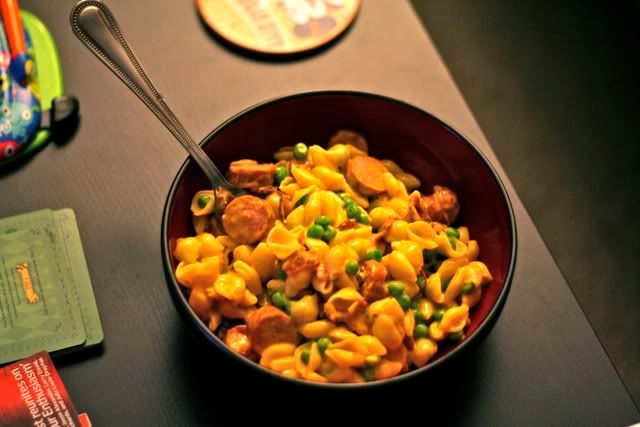 What kid doesn't love hot dog coins cut up into their macaroni and cheese? It's a classic, middle class kid dish (probably lower class, too...hell, why shouldn't rich kids enjoy it? There's nothing not to like!). This recipe goes a step further by adding in bacon and peas. I was apprehensive about the peas. When I was growing up, peas were pretty much the only food I wouldn't eat. That distaste carried over well into adulthood, and only recently have I started exploring the pea as an option for eating, and not just princess-sussing. Thankfully, the little frozen pellets (don't worry, they thaw and cook in the dish) were pretty much flavorless in the context of the dish. Crisis averted. The bacon, on the other hand, was a genius addition. This should go without saying; bacon pretty much makes everything better. That smoky, salty, cured meat made a simple dish feel classier than it actually was.
And now, a sidebar on turkey bacon. When I cook bacon, I expect to have enough grease left in the pan to cook some eggs or something. I used my non-stick skillet, since I didn't feel like getting out the fancy stuff to make a childhood dish, and the bacon still stuck quite a bit. When I finished, the pan was bone dry. Now, the flavor was still pretty good, but I have a hard time really referring to turkey bacon as true bacon. That is all. End sidebar.
This recipe concedes the fact that most of the cooking instructions for it are printed on the box of macaroni and cheese. I appreciated the candor. However, as you may have noticed in the picture, we opted not to buy the standard Kraft blue box of mac and cheese. We went with Velveeta (still a brand name, kids, it's ok) shells and cheese. I could say I did this because I am a grown up and don't need my food to be shaped like Spongebob, or that I prefer the convenience of a bag of pre-made cheese-like substance to a powdery mix to which I have to add milk and margarine. Both of those are true, but the real reason is that I grabbed the Kraft, noticed that it called for the margarine, realized I didn't have any at home, and didn't feel like going back a few aisles at the store to pick some up. Laziness informed this decision, and I'm not going to apologize for that.
The recipe instructs you, once the meal is done, to pour it into a casserole dish, cover it with foil, and put it in a turned off oven. Then, when people come over, you can take it out and pretend like you made something fancy. Well, it was just Melissa and I last night, and we sure don't stand on ceremony. Straight from the pot and into our bowls it went. We probably make shells and cheese as a "man, I don't feel like cooking" recipe more often than I care to admit. The simple addition of a couple of meats made me feel more like I was eating a real meal than when we just have the Velveeta-y pasta, and I was less embarrassed by it. We both agreed that it was a pretty satisfying "comfort food" type meal. We might have to keep hot dogs and bacon on hand for next time we need that easy Shells and Cheese fix.
Cheers,
Eli
What kid doesn't love hot dog coins cut up into their macaroni and cheese? It's a classic, middle class kid dish (probably lower class, too...hell, why shouldn't rich kids enjoy it? There's nothing not to like!). This recipe goes a step further by adding in bacon and peas. I was apprehensive about the peas. When I was growing up, peas were pretty much the only food I wouldn't eat. That distaste carried over well into adulthood, and only recently have I started exploring the pea as an option for eating, and not just princess-sussing. Thankfully, the little frozen pellets (don't worry, they thaw and cook in the dish) were pretty much flavorless in the context of the dish. Crisis averted. The bacon, on the other hand, was a genius addition. This should go without saying; bacon pretty much makes everything better. That smoky, salty, cured meat made a simple dish feel classier than it actually was.And now, a sidebar on turkey bacon. When I cook bacon, I expect to have enough grease left in the pan to cook some eggs or something. I used my non-stick skillet, since I didn't feel like getting out the fancy stuff to make a childhood dish, and the bacon still stuck quite a bit. When I finished, the pan was bone dry. Now, the flavor was still pretty good, but I have a hard time really referring to turkey bacon as true bacon. That is all. End sidebar.
This recipe concedes the fact that most of the cooking instructions for it are printed on the box of macaroni and cheese. I appreciated the candor. However, as you may have noticed in the picture, we opted not to buy the standard Kraft blue box of mac and cheese. We went with Velveeta (still a brand name, kids, it's ok) shells and cheese. I could say I did this because I am a grown up and don't need my food to be shaped like Spongebob, or that I prefer the convenience of a bag of pre-made cheese-like substance to a powdery mix to which I have to add milk and margarine. Both of those are true, but the real reason is that I grabbed the Kraft, noticed that it called for the margarine, realized I didn't have any at home, and didn't feel like going back a few aisles at the store to pick some up. Laziness informed this decision, and I'm not going to apologize for that.
The recipe instructs you, once the meal is done, to pour it into a casserole dish, cover it with foil, and put it in a turned off oven. Then, when people come over, you can take it out and pretend like you made something fancy. Well, it was just Melissa and I last night, and we sure don't stand on ceremony. Straight from the pot and into our bowls it went. We probably make shells and cheese as a "man, I don't feel like cooking" recipe more often than I care to admit. The simple addition of a couple of meats made me feel more like I was eating a real meal than when we just have the Velveeta-y pasta, and I was less embarrassed by it. We both agreed that it was a pretty satisfying "comfort food" type meal. We might have to keep hot dogs and bacon on hand for next time we need that easy Shells and Cheese fix.
Cheers,
Eli
Tuesday, September 1, 2009
Childhood Sandwich (p.36)
Once again, I find myself feeling a certain kinship with Roast Beef (the character, not the food, though I enjoy the food, as well). His Childhood Sandwich is not entirely different from my own, though I dare say that the memories he attaches to his childhood are much less pleasant than mine. Like I said when I introduced him, he's from circumstances. I'm really not.
At it's heart, this is a bologna and cheese sandwich. Which was once a favorite of mine, and still brings up a wave of nostalgia any time I prepare one for myself. My personal childhood sandwich was bologna, cheese, and butter/margarine. This recipe calls for two slices of bologna, one slice of cheese (two if you've been good or "got an A"- neither of which particularly applied to me, so I stuck with one), mustard, and lettuce. Obviously the big differences were the leaves and the condiment. As the book points out, Roast Beef's primal sense must have kicked in and told him that the perfect elements for a sandwich include a meat, a cheese, a vegetable, and a dressing. I guess my childhood self (or, more likely, my parents' parenting selves) just didn't see the need for the vegetable. It never bothered me before, and it certainly won't now.
This recipe had a few options: toasted or non-toasted bread (I went with non, I have to refrigerate my lunch for half a day before I eat it, and refrigeration takes some of the magic out of toast), one slice of cheese or two (see above), whether or not to eat a 1/2 cup of chocolate chips afterward (the recipe description says this isn't really necessary if you're a grown up- I tend to agree. Not because it wouldn't be good, but I have a half marathon this weekend, you know). It also instructs you to cut it diagonally down the middle, so you can see the layering. Mission Accomplished:
 That's the office where I eat my lunch. Please try to refrain from stalking me there. Anyway, I don't usually cut my sandwiches for lunch, it's too much hassle for a presentation that only I will see. But I have to admit, this was damn attractive. The interplay of colors and lines was more aesthetically pleasing than a childhood sandwich has a right to be. Maybe I'll have to do this more often. The recipe also instructed to use brand names, as that kind of thing is important to a child (which is true). I didn't disappoint. Oscar Mayer™ bologna, Kraft™ cheese, and Sara Lee™ bread made for one corporate sandwich.
And how was the taste, you ask? That's right, I know what you're thinking. The sandwich was a more refined take on a fond memory of the past. The lettuce gave the sandwich a real heft that made it feel more like something I'd get at a restaurant (you know, one of those cheap deli counter type places) than something I made as a child. I personally wouldn't have put mustard on a bologna and cheese, it just seems inherently, basically wrong to a person who is accustomed to the salty sweetness of butter/margarine (whichever one the health experts claimed was better for you in any given week). But, I was happily surprised to find that the tang of the mustard complemented the meat without overpowering too much (maybe just a little), though I didn't necessarily taste much of the cheese.
I have a lot of ingredients left over (you can't buy single serving bologna- I dare you to try), so I'll be making this sandwich for lunch for the rest of this week (and maybe some of next). I think I'll switch back to butter (or possibly mayo), though, for old times' sake. Now if only Planters still made Cheez Balls.

Sigh.
Cheers,
Eli
p.s.- You may have noticed I opted for the "bologna" spelling over the "baloney" spelling. That's because I'm a grown up. Also, it's how Oscar Meyer™ spells it (though I probably would have bet you it was the other way around).
At it's heart, this is a bologna and cheese sandwich. Which was once a favorite of mine, and still brings up a wave of nostalgia any time I prepare one for myself. My personal childhood sandwich was bologna, cheese, and butter/margarine. This recipe calls for two slices of bologna, one slice of cheese (two if you've been good or "got an A"- neither of which particularly applied to me, so I stuck with one), mustard, and lettuce. Obviously the big differences were the leaves and the condiment. As the book points out, Roast Beef's primal sense must have kicked in and told him that the perfect elements for a sandwich include a meat, a cheese, a vegetable, and a dressing. I guess my childhood self (or, more likely, my parents' parenting selves) just didn't see the need for the vegetable. It never bothered me before, and it certainly won't now.
This recipe had a few options: toasted or non-toasted bread (I went with non, I have to refrigerate my lunch for half a day before I eat it, and refrigeration takes some of the magic out of toast), one slice of cheese or two (see above), whether or not to eat a 1/2 cup of chocolate chips afterward (the recipe description says this isn't really necessary if you're a grown up- I tend to agree. Not because it wouldn't be good, but I have a half marathon this weekend, you know). It also instructs you to cut it diagonally down the middle, so you can see the layering. Mission Accomplished:
That's the office where I eat my lunch. Please try to refrain from stalking me there. Anyway, I don't usually cut my sandwiches for lunch, it's too much hassle for a presentation that only I will see. But I have to admit, this was damn attractive. The interplay of colors and lines was more aesthetically pleasing than a childhood sandwich has a right to be. Maybe I'll have to do this more often. The recipe also instructed to use brand names, as that kind of thing is important to a child (which is true). I didn't disappoint. Oscar Mayer™ bologna, Kraft™ cheese, and Sara Lee™ bread made for one corporate sandwich.And how was the taste, you ask? That's right, I know what you're thinking. The sandwich was a more refined take on a fond memory of the past. The lettuce gave the sandwich a real heft that made it feel more like something I'd get at a restaurant (you know, one of those cheap deli counter type places) than something I made as a child. I personally wouldn't have put mustard on a bologna and cheese, it just seems inherently, basically wrong to a person who is accustomed to the salty sweetness of butter/margarine (whichever one the health experts claimed was better for you in any given week). But, I was happily surprised to find that the tang of the mustard complemented the meat without overpowering too much (maybe just a little), though I didn't necessarily taste much of the cheese.
I have a lot of ingredients left over (you can't buy single serving bologna- I dare you to try), so I'll be making this sandwich for lunch for the rest of this week (and maybe some of next). I think I'll switch back to butter (or possibly mayo), though, for old times' sake. Now if only Planters still made Cheez Balls.
Sigh.
Cheers,
Eli
p.s.- You may have noticed I opted for the "bologna" spelling over the "baloney" spelling. That's because I'm a grown up. Also, it's how Oscar Meyer™ spells it (though I probably would have bet you it was the other way around).
Thursday, August 27, 2009
Hell Baby (p.48)
According to today's Achewood, it would appear that Roast Beef has died. It's a long story, and I'm not sure I understand it yet. It involves Williams & Sonoma, a creepy character named Cartilage Head, sapphic erotica, and something called the Lash of Thanatos. Granted, Roast Beef has died several times before, but who knows where this will lead. In any case, it makes for a good introduction to the Hell Baby.
 This is basically an arrangement of breakfast foods designed to look like a baby that came from hell. Mission accomplished. Once again, not really a recipe (it didn't tell you how to cook an egg or bacon), but it made for a good "breakfast for dinner" meal (there's a lot of breakfasts in this book, by the way). A fried egg for the head, ham steak for the body, sausages for the arms, and bacon for the pants. The recipe notes that toast triangles could be used for shoes, but that Roast Beef feels this makes the baby less hellish. I agreed. Plus, the baby's legs were already hanging off the plate, so there was nowhere for shoes to go. The ham steak I bought was giant. It appeared in the recipe diagram like you should use a whole one as the body, but if it was drawn to scale, they were using a much smaller steak than mine. I cut it in half. It was a very nice ham, though, and not too salty. Melissa even ate most of hers and she doesn't usually eat ham or pork. I was so proud.
I also had a couple of extra sausages, so I made the baby a walking stick. In my head, I thought that an old man baby that needed a cane (like Benjamin Button) would be appropriately hellish and evil (like Benjamin Button-the movie, not the character). I considered making the sausage a hell baby penis, but got embarrassed when I realized people in my family would read this. Of course, I went ahead and mentioned it anyway, so I probably should have done it. To complete the macabre display, I added a personal touch to my baby - cheese grits (this was the other meal overpowered by the sharp cheddar, if you're keeping score). I didn't like grits when I lived in the South, mostly out of principle, but now I find that if I mix some cheese or bacon bits in they can be a pretty tasty breakfast. So, I made my Hell Baby vomit up some cheese grits:
 One more thing I'd like to mention- Roast Beef says that "traditionally" the Hell Baby's pants are made of tripe, but that it's not a fashionable meat so he substituted bacon. I literally had to look up to make sure this wasn't a traditional dish somewhere. This is something that Achewood is very good at- creating back stories, histories, and traditions and making them seem like something everyone should have always been familiar with. It really makes the world of the comic feel real, and it's a very nice touch.
This is the last recipe I'm trying this week, but it's worth bringing up that I will be eating Achewood again before I return. We made Pat's Fool's Rice again for a stir fry last night, and tonight we're repeating the Toasted Nut Orzo, since we had so enough of all of the ingredients left over. That's all for now, see you all next week! (Unless something fun or exciting happens before then, in which case I'll post a regular, non-Selzer & Smuckles entry).
Cheers,
Eli
This is basically an arrangement of breakfast foods designed to look like a baby that came from hell. Mission accomplished. Once again, not really a recipe (it didn't tell you how to cook an egg or bacon), but it made for a good "breakfast for dinner" meal (there's a lot of breakfasts in this book, by the way). A fried egg for the head, ham steak for the body, sausages for the arms, and bacon for the pants. The recipe notes that toast triangles could be used for shoes, but that Roast Beef feels this makes the baby less hellish. I agreed. Plus, the baby's legs were already hanging off the plate, so there was nowhere for shoes to go. The ham steak I bought was giant. It appeared in the recipe diagram like you should use a whole one as the body, but if it was drawn to scale, they were using a much smaller steak than mine. I cut it in half. It was a very nice ham, though, and not too salty. Melissa even ate most of hers and she doesn't usually eat ham or pork. I was so proud.I also had a couple of extra sausages, so I made the baby a walking stick. In my head, I thought that an old man baby that needed a cane (like Benjamin Button) would be appropriately hellish and evil (like Benjamin Button-the movie, not the character). I considered making the sausage a hell baby penis, but got embarrassed when I realized people in my family would read this. Of course, I went ahead and mentioned it anyway, so I probably should have done it. To complete the macabre display, I added a personal touch to my baby - cheese grits (this was the other meal overpowered by the sharp cheddar, if you're keeping score). I didn't like grits when I lived in the South, mostly out of principle, but now I find that if I mix some cheese or bacon bits in they can be a pretty tasty breakfast. So, I made my Hell Baby vomit up some cheese grits:
One more thing I'd like to mention- Roast Beef says that "traditionally" the Hell Baby's pants are made of tripe, but that it's not a fashionable meat so he substituted bacon. I literally had to look up to make sure this wasn't a traditional dish somewhere. This is something that Achewood is very good at- creating back stories, histories, and traditions and making them seem like something everyone should have always been familiar with. It really makes the world of the comic feel real, and it's a very nice touch.This is the last recipe I'm trying this week, but it's worth bringing up that I will be eating Achewood again before I return. We made Pat's Fool's Rice again for a stir fry last night, and tonight we're repeating the Toasted Nut Orzo, since we had so enough of all of the ingredients left over. That's all for now, see you all next week! (Unless something fun or exciting happens before then, in which case I'll post a regular, non-Selzer & Smuckles entry).
Cheers,
Eli
Subscribe to:
Posts (Atom)